States Of Matter
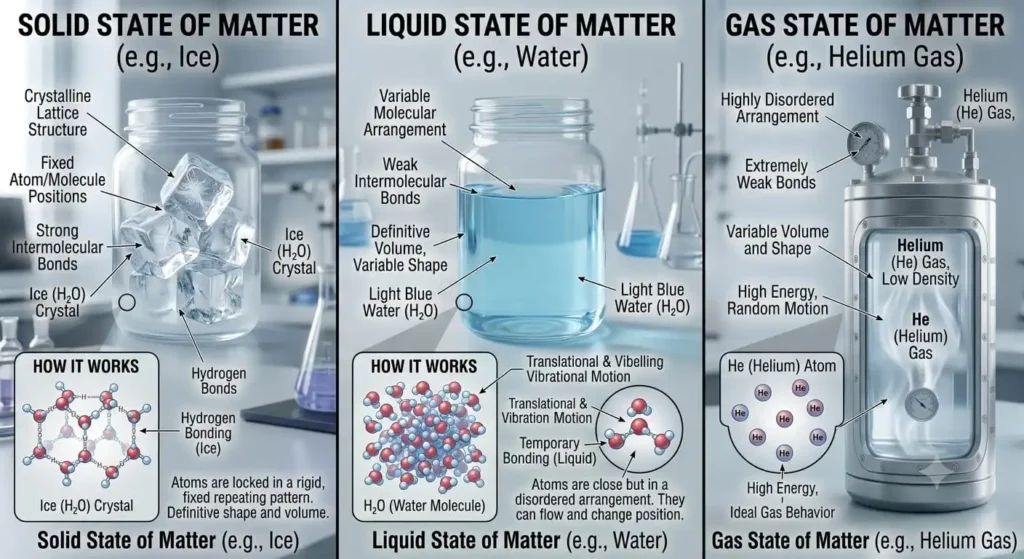
The Forms and structural conditions in which matter exist due to kinetic energy of its particles and the strength of the forces binding them are called States of Matter.
By Varying temperature and pressure states of matter can be converted into one another.
States of matter are give bellow:
Solid State of Matter:
In solids, particles are tightly packed in rigid, fixed positions with minimal kinetic energy, giving them a definite shape and volume.
Examples of Solid State of Matter:
Steel (Crystalline Solid):
Steel is a hard, strong metal made by mixing iron and carbon along with some amount of other metals such as Zinc (Zn), Nickel (Ni),Copper(Cu) and Cobalt(Co). It often has other materials added to it. People use steel to build large things like houses, bridges, cars, and tools because it is very tough and does not break easily.
Silicon (Semiconductor Solid):
Silicon is a solid non metal with atomic number 14 and atomic mass 28.It work as Semiconductor.
Used as the core substrate in computer microprocessors and solar panel photovoltaic cells.
Ice (Hydrogen-Bonded Solid):
Ice is solid form of water in which particles( H2O molecules) are highly organized.It has lower density than water due to spaces between parties in it that’s why Ice float on water.Ice is used in refrigeration, thermal management, and food preservation.
Liquid State of Matter:
In liquids, particles remain close together but possess enough thermal kinetic energy to slide past one another, maintaining a fixed volume while conforming to the shape of their container.
Examples of Liquid State of Matter:
Petroleum / Crude Oil:
Petroleum is a fossil fuel made by decomposition of organic Matter. Refined into gasoline, diesel, and lubricants that power global transport networks.
Hydraulic Fluid:
Hydraulic fluid is used to transfer power and energy in machinary.It is also used for cooling purposes.Hudraulic Fluid is Incompressible liquid used in aircraft braking systems, heavy excavators, and manufacturing machinery.
Liquid Nitrogen (LN2):
Liquid N2 is a clear liquid with no odor. It exist in liquid State at very low temperature about lower that -196°C(boiling poin of liquid nitrogen). Liquid Nitrogen is used in medical field for preserved storage of organs, blood and other bodies.It is also used for instant food freezing.
Gas State of Matter:
In gases, high kinetic energy overcomes attractive intermolecular forces, allowing particles to spread far apart and fill the full volume and shape of any container.
Examples of Gaseous State of Matter:
Liquefied Petroleum Gas (LPG ):
LPG is mainly consist of Propane (C3H8) and Butane (C4H10) gases along with smelling agents to notice gas leakage.LPG is used for domestic heating and cooking.It is stored in cylinders.
Hydrogen gas(H2);
Hydrogen gas is lightest gas which has atomic mass 2.Hydrogen gas molecules are consist of two Hydrogen atom bonded by Non polar covalent bond. It has no color,smell and taste.Hydrogen gas is flammable and used as fuel.
Helium (He) gas:
Helium is a non metal Noble gas with atomic number 2 and atomic mass 4. Helium gas is Non-flammable, low-density gas used for cooling MRI machine superconducting magnets and inflating meteorological balloons.
compress Natural Gas (CNG):
CNG is consist of Methane gas.It is used in public transport like cars and vans.CNG is cheaper than gasoline (petrol)and diesel and generate less toxic and harmful gases.
Plasma State of Matter:
Plasma is an ionized gas created when extreme thermal energy strips electrons from atomic nuclei, producing a sea of free electrons and positively charged ions. It is the most abundant state of matter in the universe.
Examples of Plasma State of Matter:
The Sun and Stars:
Natural nuclear fusion reactors sustained by high-energy plasma.
Industrial Plasma Cutters:
High-velocity jets of ionized gas used in manufacturing to cut through thick stainless steel and aluminum.
Neon and Fluorescent Lighting:
Low-pressure plasma columns energized by electricity to produce interior illumination.
Nuclear Fusion Reactors (Tokamaks):
Experimental energy projects (like ITER) that confine magnetic plasma to produce carbon-free power.
Exotic States of Matter:
Exotic states of matter are distinct physical phases that occur under extreme environmental conditions—such as absolute zero temperatures. Unlike everyday solids, liquids, gases, or high-temperature plasmas, these states are governed almost entirely by complex quantum mechanical forces.
Examples of Exotic States of Matter:
Bose-Einstein Condensate (BEC):
Bose Einstein condensate was discovered at extreme temperatures nearing absolute zero (-273.15C).
A Bose-Einstein Condensate causes individual atoms to lose separate identities and merge into a single macroscopic quantum wave function.
Examples of Bose Einstein Condensate:
Rubidium Quantum Experiments:
Ultra-cold atomic vapors used in precision measurement research.
Quantum Computing & Sensing:
Leveraged to construct ultra-precise atomic clocks and gravitational sensors for space navigation.
Fermionic Condensate:
Similar in concept to Bose-Einstein condensates, a fermionic condensate is formed by fermions (particles with half-integer spin, such as electrons, protons, and neutrons). Because the Pauli Exclusion Principle prevents fermions from occupying the same quantum state, they must first pair up at ultra-cold temperatures (forming Cooper pairs) to behave like bosons and collapse into a single quantum state.
Examples of Fermi Condensate:
Supercooled Potassium-40 and Lithium-6 gas cooled to near absolute zero in laboratory optical traps are examples of Fermi Condensate.
Quark-Gluon Plasma (QGP):
Examples of Quark-Gluon plasma :
Microscopic fireballs generated inside high-energy particle accelerators like the Large Hadron Collider (LHC) at CERN or the Relativistic Heavy Ion Collider (RHIC) during lead/gold ion collisions.
Superfluidity (Superfluids):
A phase where a liquid reaches near-zero viscosity, allowing it to flow without any friction or loss of kinetic energy is called Superfluid. Superfluids can creep up and over the walls of containers, pass through microscopic pores.
Example of Superfluid:
Liquid Helium-4 (cooled below 2.17K), causing it to transition into a frictionless quantum fluid is example of Superfluid.
Super solid:
A phase that simultaneously exhibits the spatial rigidity of a crystalline solid and the frictionless flow of a superfluid is called Supersolid. In a Supersolid, atoms are arranged in a periodic crystal lattice while simultaneously moving without friction through that same lattice.
Examples of Supersolid:
Quantum gases of Dysprosium or Erbium atoms cooled in optical lattices near absolute zero ate examples of Supersolid.
Phase(State) Transitions of Matter:
A phase transition (or change of state) is the physical transformation of matter from one phase—solid, liquid, gas, or plasma—to another. This shift occurs when energy (heat or pressure) is added to or removed from a system, changing how tightly its particles are bound together without altering its chemical identity.
FAQs – States of Matter
States of Matter
Conclusion
Matter exists in different physical states, with solids, liquids, and gases being the three most commonly studied states. These states differ in particle arrangement, movement, volume, and shape. For standardized chemical terminology and scientific definitions, readers can consult the IUPAC Gold Book.