
Atomic Mass vs Mass Number:
Understanding atomic mass vs mass number is essential for learning atomic structure and solving basic chemistry problems. Although these terms are related, they do not mean the same thing. Atomic mass is the average mass of an element’s naturally occurring isotopes, while the mass number is the total number of protons and neutrons in a particular atom.
What Is Atomic Mass?
Atomic mass is the average mass of the atoms of an element, taking into account the relative abundance of its naturally occurring isotopes. Usually it is expressed in atomic mass units (u or amu).
For example, chlorine has two common isotopes, chlorine-35 and chlorine-37. Because these isotopes occur in different proportions, chlorine’s atomic mass is approximately 35.45 u, rather than exactly 35 or 37.
Atomic Mass Definition
In simple terms, atomic mass is the weighted average mass of an element’s isotopes based on their natural abundance.
The mass of an atom is mainly determined by its protons and neutrons, while electrons contribute only a very small amount.
If you want to review the particles that make up an atom, see What is a proton? and What is an electron?.
Atomic Mass Formula
The general atomic mass formula is:
Atomic mass = Σ (isotopic mass × fractional abundance)
For example, if an element has two isotopes, its atomic mass can be calculated as:
Atomic mass = (mass of isotope 1 × abundance of isotope 1) + (mass of isotope 2 × abundance of isotope 2)
Remember to convert percentage abundance into a decimal before performing the calculation.
How to Calculate Atomic Mass
To calculate atomic mass:
- Identify the isotopes of the element.
- Find the mass of each isotope.
- Determine the natural abundance of each isotope.
- Convert percentages into decimals.
- Multiply each isotopic mass by its fractional abundance.
- Add the results.
This calculation gives the weighted average atomic mass, which is the value generally shown on the periodic table.
John Dalton’s Experiment and Atomic Mass
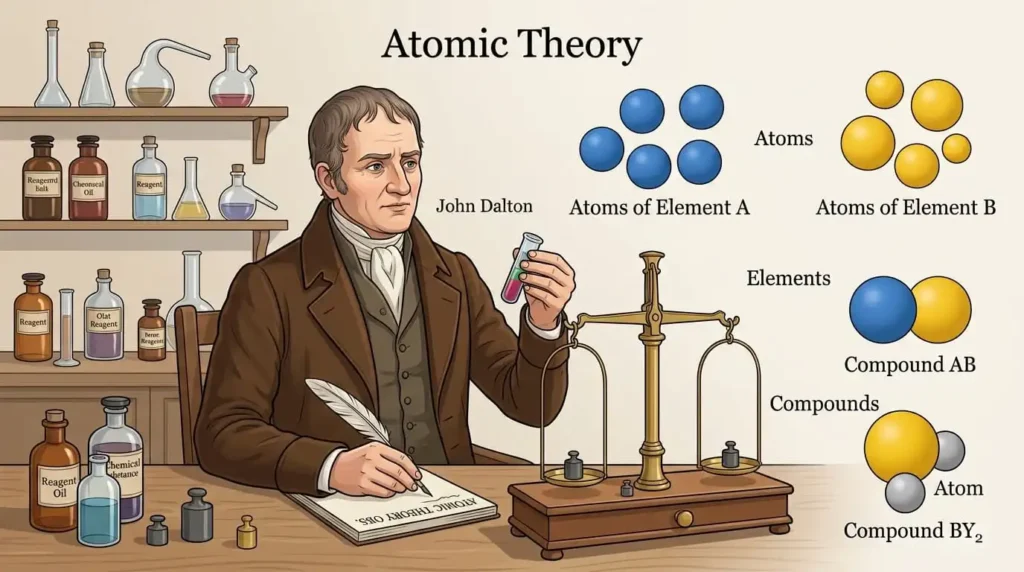
John Dalton developed the early modern atomic theory in the early 19th century. His work was based on chemical combination laws and the idea that elements consist of tiny particles called atoms.
Dalton proposed that atoms of the same element have the same mass and properties. Modern science later showed that atoms of the same element can have different masses because of isotopes. This discovery refined Dalton’s original model and helped scientists understand why an element can have a non-whole-number atomic mass.
Atomic Mass and Atomic Number
Atomic number and atomic mass describe different properties of an element.
- Atomic number (Z) = number of protons in the nucleus.
- Atomic mass = weighted average mass of the naturally occurring isotopes.
- Atomic number identifies the element, while atomic mass represents its average isotopic mass.
For example, every carbon atom has 6 protons, so carbon’s atomic number is 6. However, carbon exists mainly as carbon-12 and carbon-13, giving naturally occurring carbon an atomic mass of about 12.01 u.
What Is Mass Number?
The mass number is the total number of protons and neutrons present in the nucleus of a particular atom or isotope.
Mass Number Definition
Mass number is combination of the number of protons and neutrons in an atom’s nucleus.
Electrons are not included because the mass number counts the nuclear particles called nucleons.
Mass Number Formula
The mass number formula is:
A = Z + N
Where:
- A = mass number
- Z = number of protons (atomic number)
- N = number of neutrons
For example, carbon-12 contains 6 protons and 6 neutrons:
A = 6 + 6 = 12
You can learn more about neutrons in What is a neutron?.
How to Calculate Mass Number
To calculate mass number, simply add the number of protons and neutrons:
Mass number = protons + neutrons
If an atom has 11 protons and 12 neutrons:
Mass number = 11 + 12 = 23
Therefore, the atom has a mass number of 23.
How to Calculate Atomic Number
The atomic number is same to the number of protons in the nucleus:
Atomic number = number of protons
For a neutral atom, the number of protons also equals the number of electrons. Therefore, if an atom contains 17 protons, its atomic number is 17.
Atomic Mass vs Mass Number
| Atomic Mass | Mass Number |
| Weighted average of isotope masses | Protons + neutrons |
| Usually a decimal | Always a whole number |
| Represents an element’s isotopic average | Represents a specific isotope |
| Measured in atomic mass units | A numerical count |
Conclusion
Knowing the difference between atomic mass vs mass number makes atomic structure much easier to understand. Atomic mass is the weighted average of an element’s isotopes, whereas mass number is the total number of protons and neutrons in a specific atom. Atomic number, meanwhile, tells us the number of protons and identifies the element. Understanding these three concepts is important for studying isotopes, periodic-table data, and chemical calculations. You also can read Average atomic mass to enhance your knowledge