
What Is a Neutron?
A neutron is a neutral subatomic particle found inside the nucleus of most atoms. It has no net electric charge and has a mass slightly greater than that of a proton. Neutrons, together with protons, make up the atomic nucleus and are therefore called nucleons. The neutron was discovered by James Chadwick in 1932 through experiments involving beryllium and penetrating radiation. This discovery helped scientists understand atomic structure, isotopes, and nuclear reactions. In this article, you will learn what a neutron is, who discovered it, how the neutron was discovered, its charge and mass, and its important properties.
What Is a Neutron?
A neutron is a subatomic particle located in the nucleus of an atom. Unlike a proton, it carries no net electric charge. Its mass is approximately 1.675 × 10⁻²⁷ kg, making it slightly heavier than a proton. Neutrons are important because they contribute to the mass and stability of atomic nuclei.
For comparison, you can learn more about the other major subatomic particles in our guides on what is an electron? and what is a proton?.
Neutron Definition
A neutron is a neutral subatomic particle found in an atomic nucleus. It has no net electric charge and a mass of about 1.675 × 10⁻²⁷ kg. Neutrons and protons together form the nucleus and are essential for understanding isotopes and nuclear stability.
james chadwick experiment
James Chadwick, a British physicist, discovered the neutron in 1932. His discovery solved an important problem in atomic physics: scientists needed to explain why atomic nuclei had more mass than could be accounted for by their positive charge alone.
Chadwick received the 1935 Nobel Prize in Physics for the discovery of the neutron. Earlier, Ernest Rutherford had proposed that a neutral particle with a mass similar to a proton might exist inside the nucleus, but experimental proof was still needed.
Neutron discovery
The neutron discovery experiment developed from earlier work by Walther Bothe and Herbert Becker. In 1930, they bombarded beryllium with alpha particles and observed a highly penetrating radiation. At first, this radiation was thought to be gamma radiation.
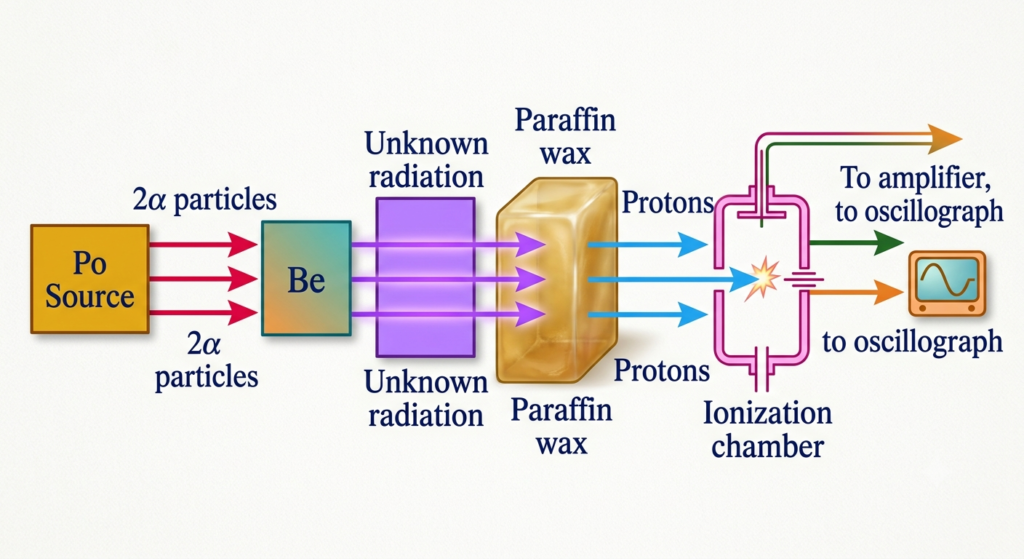
Chadwick investigated the radiation more carefully. The main steps were:
- Alpha particles bombarded beryllium: A radioactive source produced alpha particles that struck a beryllium target.
- Penetrating radiation was produced: The beryllium emitted a highly penetrating radiation.
- Paraffin wax was exposed: When the radiation struck paraffin, which contains hydrogen, fast-moving protons were ejected.
- Energy measurements were made: Chadwick studied the energies and collisions of the emitted particles.
- A neutral particle was proposed: The results could not be explained satisfactorily by gamma rays.
- The neutron was identified: Chadwick concluded that the radiation consisted of neutral particles with a mass close to that of the proton.
The simplified nuclear reaction can be written as:
⁹Be + ⁴He → ¹²C + ¹n
This experiment provided strong evidence for the existence of the neutron.
Charge of neutron
The net electric charge of a neutron is zero. Therefore, a neutron is electrically neutral. This is one of its most important differences from the proton, which has a positive charge, and the electron, which has a negative charge.
Although the neutron has no net electric charge, it is not completely structureless. It is a composite particle made of quarks and has a measurable magnetic moment. NIST lists the neutron’s charge as experimentally constrained to an extremely small value consistent with zero.
Mass of a neutron
The mass of a neutron is approximately:1.67492750056 × 10⁻²⁷ kg or 1.00866491606 atomic mass units (u).
Its mass is slightly greater than the mass of a proton. The neutron’s mass-energy equivalent is about 939.565 MeV. These values are based on the 2022 CODATA recommended constants reported by NIST.
Neutron properties
The important properties of a neutron include:
| Property | Value / Description |
| Particle type | Subatomic particle |
| Location | Atomic nucleus |
| Electric charge | 0 |
| Mass | 1.67492750056 × 10⁻²⁷ kg |
| Mass in atomic units | 1.00866491606 u |
| Symbol | n or ¹n |
| Spin | 1/2 |
| Classification | Baryon |
| Composition | One up quark and two down quarks |
| Role | Contributes to nuclear mass and stability |
Neutrons also play a major role in nuclear reactions. Because they have no net electric charge, they can approach atomic nuclei without experiencing the electrostatic repulsion that affects charged particles. This property makes neutrons particularly useful in nuclear research and reactions.
Importance of neutron
Neutrons help determine which isotope an element has. Atoms of the same element have the same number of protons but can contain different numbers of neutrons. This difference produces isotopes with different masses and, in some cases, different nuclear stability.
Neutrons are also important in nuclear fission, neutron scattering, nuclear research, and several scientific and technological applications. Their ability to interact directly with atomic nuclei makes them valuable tools for studying matter.
Conclusion
A neutron is a neutral subatomic particle located in the atomic nucleus. James Chadwick discovered it in 1932 through experiments involving beryllium radiation and paraffin. With zero net charge and a mass of approximately 1.675 × 10⁻²⁷ kg, the neutron is essential to the structure and stability of atomic nuclei. Understanding neutron properties also helps explain isotopes and nuclear reactions.
Frequently Asked Questions About Neutrons
Neutorn
Authoritative References
- Nobel Prize — James Chadwick and the discovery of the neutron
- NIST — CODATA Recommended Fundamental Physical Constants
- Nobel Prize — 1935 Physics Prize and neutron discovery
Want to learn more about atomic structure? Explore our guides on electrons and protons to build a stronger foundation in chemistry.