
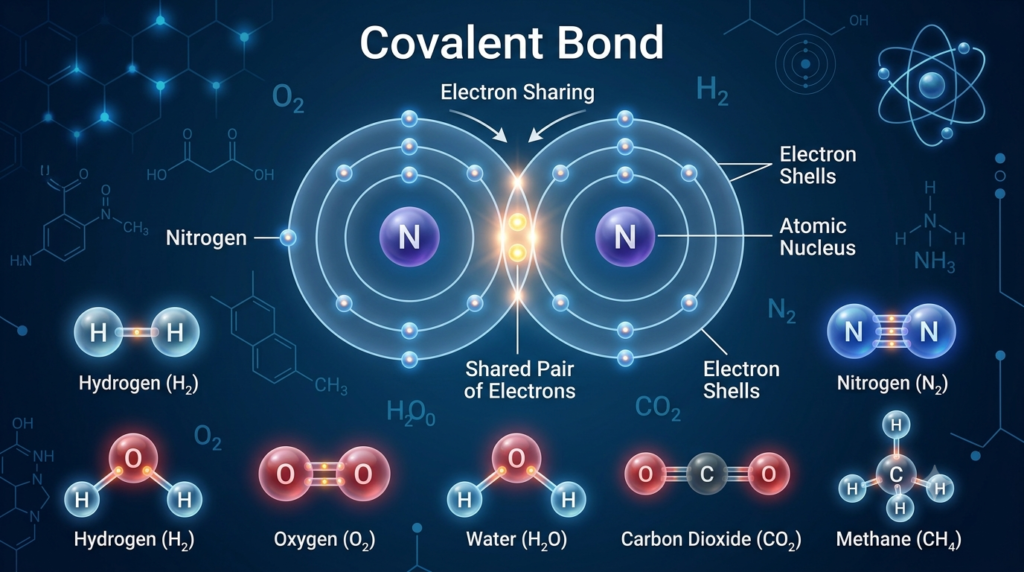
What Is a Covalent Bond?
A covalent bond is a chemical connection formed when two atoms share one or more electron pairs.Instead of transferring electrons from one atom to another, both atoms contribute electrons and share them equally or unequally to achieve a stable electron configuration.
This sharing allows the atoms to complete their outermost electron shell, making the molecule more stable. As a result, both atoms achieve lower energy and greater stability.
Definition of Covlent bond
A covalent bond is created through the sharing of one or more pairs of electrons between two atoms.
Examples include:
Hydrogen (H₂)
Oxygen (O₂)
Nitrogen (N₂)
Water (H₂O)
Carbon Dioxide (CO₂)
Methane (CH₄)
Ammonia (NH₃)
How Does a Covalent Bond Form?
Atoms naturally seek stability by completing their outermost electron shell, also known as the valence shell. However, many non-metal atoms do not have enough electrons to become stable on their own.
Instead of losing or gaining electrons, these atoms share electrons with neighboring atoms. Consequently, each atom counts the shared electrons as part of its own valence shell.
For example, a hydrogen atom has one electron and requires one more to achieve stability. When two hydrogen atoms come close together, each contributes one electron. Together, they form a shared electron pair, creating a single covalent bond.
This process is simple, yet it is responsible for forming millions of molecules in our universe.
Why Do Atoms Share Electrons?
Atoms share electrons for several important reasons:
Achieve a stable electronic configuration.
Complete the octet (or duet in hydrogen).
Lower their potential energy.
Because of these reasons, covalent bonding is one of the strongest and most significant bonding mechanisms in chemistry
Characteristics of Covalent Bonds
Covalent bonds possess several unique characteristics that distinguish them from ionic bonds.
Key Features
Formed mainly between non-metal atoms.
Electrons are shared, not transferred.
Can involve one, two, or three shared electron pairs.
Produce stable molecules.
Covalent compounds generally have lower melting and boiling points compared to ionic compounds.These characteristics help explain why substances like water, methane, and carbon dioxide behave differently from ionic compounds such as sodium chloride.
Covalent Bond Formation According to the Octet Rule
These compounds usually have lower melting and boiling points than ionic compounds.However, hydrogen is an exception because it becomes stable with only two electrons.
For example:
Hydrogen shares one valence electron to obtain a full first energy level.
Oxygen shares two electrons.
Nitrogen shares three electrons.
Carbon shares four electrons.
As a result, stable covalent molecules are formed.
Importance of Covalent Bonds
Covalent bonding is far more important than many students initially realize. In fact, almost every living organism depends on covalent compounds.
Some major reasons include:
Formation of water molecules.
Building DNA and RNA.
Formation of proteins.
Formation of carbohydrates.
Production of medicines.
Manufacturing plastics.
Development of fuels.
Formation of countless organic compounds.
Without covalent bonds, life as we know it would be impossible.
Types of covlant Bonds
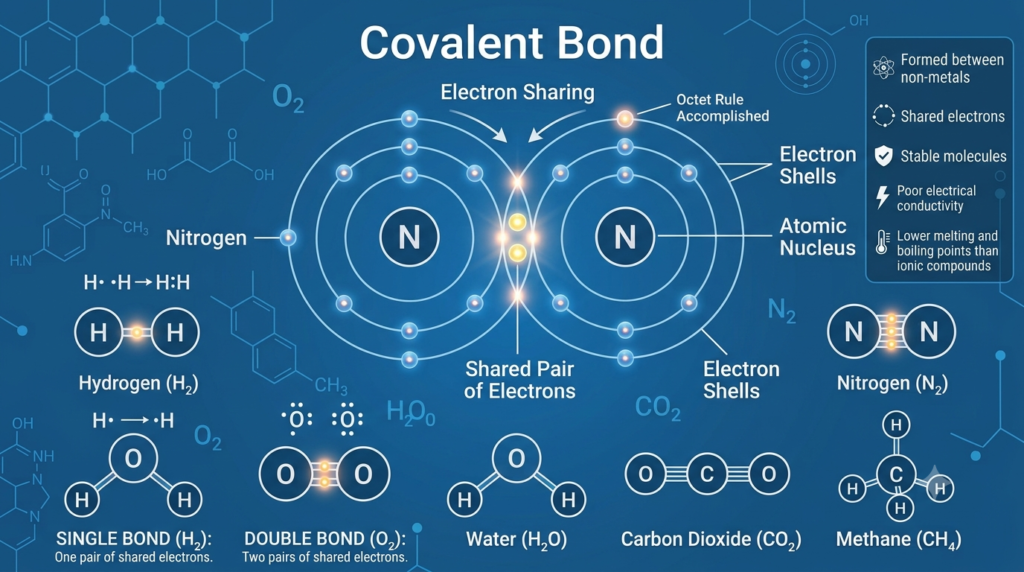
Covalent bonds are classified according to the number of electron pairs shared between two atoms. Depending on the number of shared electrons, a covalent bond may be a single bond, double bond, or triple bond. Each type has unique properties that influence the stability and behavior of molecules.
Understanding these types is essential because they explain why molecules have different shapes, strengths, and chemical properties.
Single Covalent Bond
A single covalent bond is formed when one pair of electrons is shared between two atoms. Since only one electron pair is shared, this bond is generally longer and weaker than double and triple bonds.
Characteristics
One shared electron pair
Represented by one line (—)
Relatively long bond length
Lower bond energy
Allows greater rotation between atoms
Examples
H₂ (Hydrogen)
Cl₂ (Chlorine)
CH₄ (Methane)
Double Covalent Bond
A double covalent bond is created through the mutual sharing of two pairs of electrons between atoms.Because more electrons are shared, double bonds are stronger and shorter than single bonds.
Characteristics
Two shared electron pairs
Represented by (=)
Shorter bond length
Higher bond energy
Stronger than a single bond
Examples
CO₂
C₂H₄ (Ethene)
Triple Covalent Bond
A triple covalent bond is formed when three pairs of electrons are shared between two atoms.
It is the strongest and shortest type of covalent bond because six electrons are shared.
Characteristics
Three shared electron pairs
Represented by (≡)
Highest bond energy
Shortest bond length
Very strong bond
Examples
N₂
HCN
Polar and Non-Polar Covalent Bonds
Polar covlent bond
Not all covalent bonds share electrons equally. Sometimes electrons are shared equally, while in other cases they are attracted more strongly by one atom.
Therefore, covalent bonds are divided into non-polar and polar covalent bonds.
Non-Polar Covalent Bond
A non-polar covalent bond is formed when the shared electrons are distributed equally between two atoms.
This usually occurs when both atoms have the same or nearly the same electronegativity.
Electronegativity Difference
0.0 – 0.4
Characteristics
Equal electron sharing
No partial positive or negative charges
No permanent dipole
Symmetrical electron distribution
Examples
H₂
Cl₂
O₂
N₂
Polar Covalent Bond
A polar covalent bond formation take place when electrons are shared unequally.
The bonding electrons are pulled closer to one atom because it has a greater electronegativity value.
As a result, one atom develops a partial negative charge (δ−), while the other develops a partial positive charge (δ+).
Electronegativity Difference
0.5 – 1.7
Characteristics
Unequal electron sharing
Presence of partial charges
Permanent dipole moment
Molecules become electrically polarized
Examples
H₂O
NH₃
HCl
SO₂
Electronegativity and Covalent Bond
| Electronegativity difference: | Bond type: |
| 0.0 – 0.4 | Non-polar Covalent |
| 0.5 – 1.7 | Polar Covalent |
| Greater than 1.7 | Mostly Ionic Bond |
Understanding electronegativity helps scientists predict bond polarity and molecular behavior.
Carbon Dioxide (CO₂)
Structure:
O = C = O
In carbon dioxide (CO₂), carbon is bonded to two oxygen atoms through double covalent bonds.
Hydrogen Cyanide (HCN)
Structure:
H—C≡N
A triple covalent bond connects carbon and nitrogen atoms.
Properties of Covalent Compounds
Covalent compounds possess unique physical and chemical properties because they are formed through the sharing of electrons rather than electron transfer. Consequently, these compounds behave differently from ionic compounds.
Main Properties
Usually formed between non-metal atoms.
Consist of discrete molecules.
Have relatively low melting and boiling points.
Generally poor conductors of electricity because they lack free ions.
Many are gases or liquids at room temperature.
Most are insoluble in water but soluble in organic solvents such as benzene and ether.
Covalent compounds often have definite molecular shapes due to directional bonding.
These properties make covalent compounds useful in a wide range of scientific and industrial applications.
Real-Life Applications of Covalent Bonds
Covalent bonds are everywhere in our daily lives. In fact, they are responsible for the formation of countless substances that support modern civilization.
Water
Every water molecule contains polar covalent bonds between hydrogen and oxygen atoms.
Human Body
Proteins, carbohydrates, fats, DNA, and RNA are all held together by covalent bonds.
Medicines
Most pharmaceutical drugs consist of covalent compounds that interact with biological molecules.
Plastics
Common plastics such as polyethylene and PVC are made of covalently bonded polymers.
Fuels
Natural gas, methane, gasoline, and many fuels contain covalent compounds that release energy during combustion.
Agriculture
Many fertilizers, pesticides, and plant growth regulators contain covalent molecules.
Food Industry
Sugar, starch, vitamins, and flavoring agents all depend on covalent bonding.
Modern Technology
Semiconductors, advanced materials, nanotechnology, and polymers rely heavily on covalent bonding.
Advantages of Covalent Bonds
Covalent bonds offer several important advantages.
Produce stable molecules.
Create a vast variety of chemical compounds.
Form the basis of organic chemistry.
Essential for all living organisms.
Allow the formation of complex biological molecules.
Provide flexibility in molecular design.
Disadvantages of Covalent Bonds
Despite their importance, covalent compounds also have certain limitations.
Poor electrical conductivity.
Many have relatively low melting points.
Some are highly flammable.
Certain covalent compounds are toxic.
Covalent compounds are less soluble in water compared to ionic compounds.
Conclusion
A covalent bond is one of the most fundamental concepts in chemistry. It is formed by the sharing of one or more pairs of electrons between atoms, enabling them to achieve stable electronic configurations. Depending on the number of shared electron pairs, covalent bonds may be single, double, or triple. Furthermore, differences in electronegativity determine whether a bond is polar or non-polar.
Covalent bonds are essential for the existence of water, oxygen, proteins, DNA, medicines, fuels, plastics, and countless other substances that support life and technology. Therefore, a solid understanding of covalent bonding provides the foundation for studying organic chemistry, biochemistry, and materials science.
Whether you are a beginner or an advanced chemistry student, mastering the concept of covalent bonds will help you understand the structure, properties, and behavior of molecules more effectively.