
Subatomic particles are the foundation of modern chemistry because they determine the structure, mass, charge, and behavior of every atom. These are electron protons and neutrons. Without understanding these particles, it is impossible to explain chemical bonding, atomic structure, or chemical reactions. Today, the study of subatomic particles plays an essential role in chemistry, physics, medicine, and many other scientific fields.
In this article, you will learn what are electrons , how they were discovered, and why they are important in understanding the structure of matter.
What Are Subatomic Particles?
Subatomic particles are incredibly tiny components that form the internal structure of an atom. They are much smaller than the atom itself and are responsible for its physical and chemical properties.
The three fundamental subatomic particles are:
Electron (e⁻) – A negatively charged particle.
Proton (p⁺) – A positively charged particle.
Neutron (n⁰) – A neutral particle with no electric charge.
Electrons move around the nucleus, while protons and neutrons are located inside the nucleus. Together, these particles determine the identity, stability, and chemical behavior of every element.
Until the end of the nineteenth century, scientists believed that atoms could not be divided into smaller parts. However, between 1879 and 1932, a series of remarkable discoveries proved that atoms contain electrons, protons, and neutrons. These discoveries completely changed the field of chemistry and gave birth to modern atomic theory.
Cathode Rays and the Discovery of the Electron
The discovery of the electron was the first major breakthrough in understanding the internal structure of the atom. In 1879, Sir William Crookes performed several experiments using a special device called a discharge tube. His work opened the door to one of the most important discoveries in chemistry.
What Is a Discharge Tube?
A discharge tube is a sealed glass tube that contains gas at extremely low pressure. It allows electric current to pass through the gas when a very high voltage is applied.
The tube contains two metal electrodes connected to a high-voltage battery.
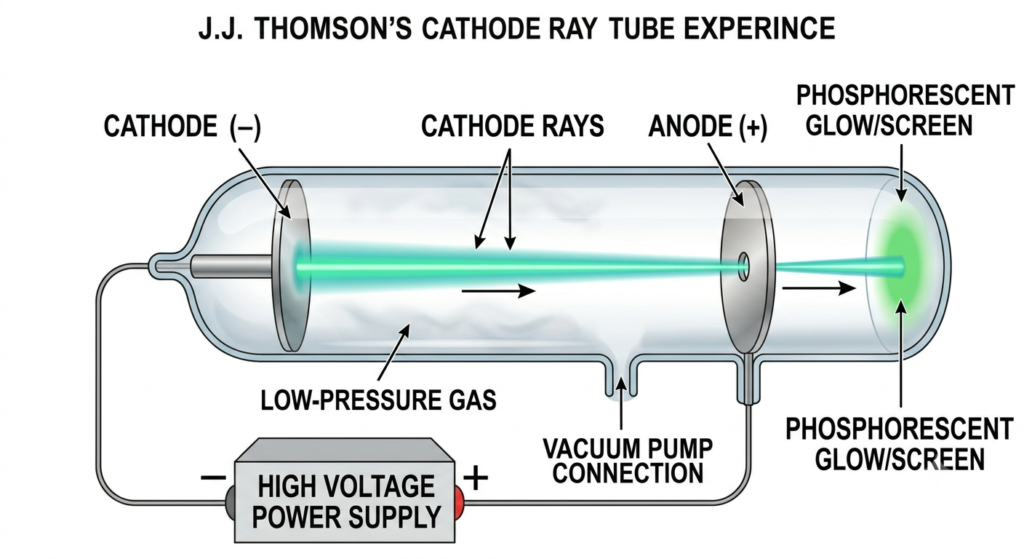
Cathode
The electrode attached to the negative terminal of a battery is known as the cathode and has a negative charge (-).
Anode
The electrode attached to the positive terminal of a battery is known as the anode and carries a positive charge (+).
The pressure inside the discharge tube is reduced to approximately 10⁻⁴ atm using a vacuum pump. When a high-voltage electric current passes through the tube, bright rays are emitted from the cathode and travel toward the anode. These rays are called cathode rays because they originate from the cathode.
Properties of Cathode Rays
Scientists carefully studied cathode rays and discovered several important properties.
They Travel in Straight Lines
Cathode rays always move in straight paths. When an object is placed in their path, it blocks the rays and produces a clear shadow. This observation proved that cathode rays travel in straight lines.
They Produce Shadows
The sharp shadows formed by cathode rays showed that they behave like streams of particles rather than ordinary light.
They Carry a Negative Charge
When an electric field is applied, cathode rays move toward the positively charged plate. Therefore, scientists concluded that these rays carry a negative electric charge
They Produce Heat
Cathode rays increase the temperature of any object they strike. This property shows that they carry energy.
They Produce Light
When cathode rays hit the glass wall of the discharge tube, the glass glows brightly. As a result, scientists could easily observe the movement of these rays during experiments.
They Are Independent of the Gas Used
Scientists noticed that the same type of cathode rays appeared regardless of the gas inside the discharge tube or the material used for the cathode. This remarkable observation proved that cathode rays are fundamental particles present in all atoms.
Their Charge-to-Mass Ratio Was Measured
Later, J. J. Thomson measured the charge-to-mass ratio (e/m) of cathode rays. His experimental results provided strong evidence that these rays consisted of tiny negatively charged particles.
Discovery of the Electron
In 1897, the English physicist J. J. Thomson performed detailed experiments on cathode rays. He demonstrated that cathode rays were not ordinary rays or waves but streams of tiny negatively charged particles moving at very high speed.
These particles were later named electrons, making them the first subatomic particles to be discovered.
The discovery of the electron completely transformed atomic theory because it proved that atoms are divisible and contain smaller fundamental particles. Furthermore, this discovery laid the foundation for modern chemistry, atomic physics, and electronics.
Electron properties
The electron is the lightest subatomic particle found in every atom. It continuously moves around the nucleus in different energy levels or shells and plays a vital role in chemical bonding and electrical conductivity.
| Property | Value |
| Symbol | e⁻ |
| Relative Charge | -1 |
| Absolute Charge | -1.602 × 10⁻¹⁹ C |
| Mass (g) | 9.109 × 10⁻²⁸ g |
| Mass (amu) | 0.00055 amu |
| Charge-to-Mass Ratio (e/m) | -1.759 × 10¹¹ C/kg |
Importance of electron
Electrons play a key role in the formation of chemical bonds by being transferred, gained, lost, or shared between atoms. They also play a crucial role in electricity, electronics, and countless chemical reactions. Therefore, understanding the electron is essential for mastering atomic structure and chemistry.
Want to explore more chemistry topics? Visit our learnchemist website to discover detailed notes, easy-to-understand explanations, diagrams, and MCQs on atomic structure, chemical bonding, the periodic table, isotopes, ions, and many other chemistry concepts. Keep learning with Learn Chemist and make chemistry simple, engaging, and enjoyable.

Frequently Asked Questions (FAQs)
What is electron?
Conclusion
The electron is one of the most important subatomic particles that helps us understand the structure and behavior of atoms. Discovered by J. J. Thomson in 1897 through cathode ray experiments, electrons changed the traditional concept of the atom and proved that atoms are divisible. Their negative charge, extremely small mass, and movement around the nucleus make them essential for chemical bonding, electricity, and chemical reactions. A clear understanding of electrons provides a strong foundation for learning advanced chemistry concepts. Explore more chemistry topics and strengthen your knowledge with easy-to-understand guides and resources.