What Is a Proton?
proton definiton
A proton is a positively charged subatomic particle that is located in the nucleus of an atom.
It has a charge of +1 and a mass of roughly 1 atomic mass unit (u).
Protons are one of the three main subatomic particles studied in chemistry, the other two being electrons and neutrons.
Protons and neutrons are found in the nucleus, while electrons are found outside of it.
The number of protons in an atom helps determine which element it is.
For instance, hydrogen has one proton, carbon has six, and oxygen has eight.This number is referred to as the atomic number.
In simple terms, a proton is a positively charged particle that plays an important role in defining the identity and structure of an atom
Proton Definition in Simple Words
A proton is a positively charged subatomic particle found in the nucleus of an atom.
Important facts about a proton include:
- Symbol: p or p⁺
- Charge: +1 elementary charge
- Electric charge: approximately +1.602 × 10⁻¹⁹ C
- Mass: approximately 1.673 × 10⁻²⁷ kg
- Relative mass: about 1 u
- Location: atomic nucleus
- Composition: two up quarks and one down quark
Because protons carry a positive charge, they contribute to the positive charge of the atomic nucleus.
Who Discovered the Proton?
The discovery of the proton is mainly credited to Ernest Rutherford.
His experiments helped show that the nucleus contains positively charged particles, and that the hydrogen nucleus is a basic part of atomic structure.
The discovery was part of the broader development in atomic science.
In 1897, J.J.Thomson discovered the electron through cathode ray experiments.This showed that atoms are not indivisible.
Later, Rutherford’s famous gold foil experiment provided evidence that an atom has a small, dense, positively charged nucleus.
His experiments involving nitrogen and alpha particles showed important evidence for the hydrogen nucleus, which was later named the proton.
For more information about atomic structure, see What Is an Atom?
Proton Discovery Experiment
Rutherford’s work in discovering the proton was closely associated with his experiments involving alpha particles.
In 1917, Rutherford bombarded nitrogen gas with alpha particles and observed particles that behaved like hydrogen nuclei.
These particles were able to travel out of the nitrogen and were identified as hydrogen nuclei.
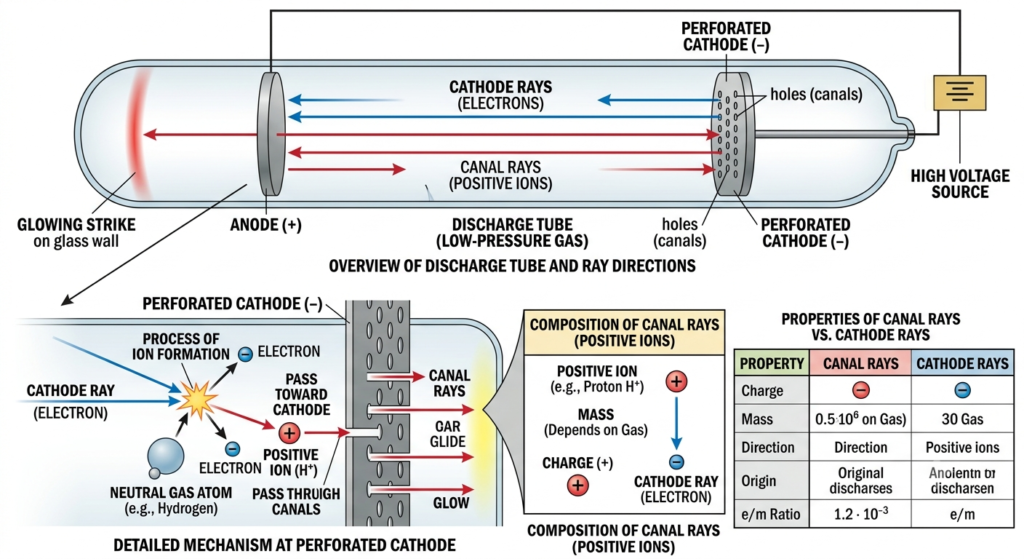
The reaction can be represented in simplified form as:
¹⁴N + ⁴He → ¹⁷O + ¹H
The emitted hydrogen nucleus was important because it showed that the hydrogen nucleus could be created during a nuclear reaction.
Rutherford concluded that the hydrogen nucleus was a fundamental part of the atomic nucleus.
This particle was later named the proton.
This experiment was a major step in understanding the composition of the atomic nucleus and the nature of matter.
Structure of a Proton
A proton is not an elementary particle.
It is a composite particle made up of smaller particles called quarks.
A proton consists of two up quarks and one down quark.
These quarks are held together by the strong interaction, which is one of the fundamental forces in nature.
The electric charges of the three valence quarks are:
- Up quark = +2/3
- Up quark = +2/3
- Down quark = −1/3
Together, these charges give the proton a total charge of +1.
(+2/3) + (+2/3) + (−1/3) = +1
Protons also contain gluons and temporary quark-antiquark pairs as part of their internal structure.
Therefore, the proton is much more complex than a simple collection of three particles.
Properties of a Proton
Positive Charge
The most important property of a proton is its positive electric charge.
Its charge is approximately +1.602 × 10⁻¹⁹ coulomb.
The proton’s charge has the same magnitude as the electron’s charge but with the opposite sign.
Mass
A proton has a mass of approximately 1.673 × 10⁻²⁷ kg.
It is about 1836 times more massive than an electron.
However, the proton’s mass is not simply the sum of the masses of its three valence quarks.Most of the proton’s mass comes from the energy associated with its internal forces and the strong interaction.
Location
Protons are found inside the atomic nucleus.
The nucleus contains protons and neutrons, which are collectively known as nucleons.
Atomic Number
The number of protons in the nucleus is known as the atomic number.
The atomic number determines the identity of an element.
For example:
Hydrogen = 1 proton
Helium = 2 protons
Carbon = 6 protons
Nitrogen = 7 protons
Oxygen = 8 protons
Sodium = 11 protons
Therefore, every element has a unique number of protons
Stability
According to the Standard Model of particle physics, proton decay has not been observed experimentally.
Its long-term stability is one reason why ordinary matter can exist for a very long time.
Proton, Neutron, and Electron
Protons, neutrons, and electrons are the three subatomic particles most commonly introduced when learning about atomic structure.
A proton has a positive charge, a neutron has no net electric charge, and an electron has a negative charge.
| Particle | Charge | Approximate Relative Mass | Location |
| Proton | +1 | 1 u | Nucleus |
| Neutron | 0 | 1 u | Nucleus |
| Electron | −1 | 1/1836 u | Outside nucleus |
Although protons and neutrons have similar masses, an electron is much lighter. For a detailed explanation, see What Is an Electron?
Definition, Discovery, and Properties.
You can also explore Neutron Definition, Properties, and Role in the Atom to understand the second major particle inside the nucleus.
Why Are Protons Important?
Protons are essential because they determine the identity of chemical elements.
For example, every carbon atom has six protons.
If an atomic nucleus contains seven protons, it is nitrogen instead of carbon.
Therefore, changing the number of protons changes the element itself.
Protons also contribute to the positive charge of the nucleus . The attraction between a positive charge and the negatively charged electrons is a key factor in the structure of atoms.
In chemistry, the number of protons in an atom is closely connected to its position on the periodic table, its electron arrangement, chemical behavior, isotopes, and the formation of ions.
Protons and Isotopes
Atoms of the same element have the same number of protons, but they can have different numbers of neutrons.
These variations are known as isotopes.
For example, all carbon atoms have six protons.
Carbon-12 contains six neutrons, carbon-13 contains seven, and carbon-14 contains eight.
The number of protons remains the same, so all three are still considered carbon.
This illustrates an important concept: the number of protons defines the element, while the number of neutrons can change across different isotopes.
Protons and Ions
A neutral atom has equal numbers of protons and electrons.
When an atom loses electrons, it becomes a positively charged ion, called a cation.
When it gains electrons, it becomes a negatively charged ion, known as an anion.
For instance, a neutral sodium atom has 11 protons and 11 electrons.
If it loses one electron, it has 11 protons and 10 electrons, giving it a charge of +1.
It would then be represented as Na⁺.
In typical chemical reactions, atoms usually gain or lose electrons, not protons.
Changing the number of protons alters the element and involves nuclear reactions.
Is a Proton a Fundamental Particle?
No, a proton is a composite subatomic particle.
It consists of quarks and gluons and belongs to a group of particles called hadrons.
More specifically, a proton is a baryon because it contains three valence quarks.
In contrast, an electron is classified as an elementary particle since no smaller internal structure has been found for it.
This distinction is crucial when studying modern particle physics.
Importance of Protons in Science and Technology
Protons are essential in many areas of modern science.
Scientists study protons to understand atomic nuclei, nuclear reactions, particle interactions, and the structure of matter.
Protons are also used in particle accelerators and have practical applications in medicine.
For example, proton therapy uses high-energy protons in certain cancer treatments because they can deliver energy precisely to a targeted region of tissue.
Proton research connects basic chemistry with nuclear physics, particle physics, medicine, and advanced technology.
Key Points
The most important facts to remember include:
- A proton is a positively charged subatomic particle.
- It is located in the atomic nucleus.
- Its relative charge is +1.
- Its mass is approximately 1 atomic mass unit.
- The number of protons determines the atomic number.
- The atomic number identifies the element.
- A proton has two up quarks and one down quark as its valence quarks.
- Protons and neutrons are referred to as nucleons.
- Protons are much more massive than electrons.
- Changing the number of protons changes the identity of an element.
Frequently Asked Questions (faq)
proton
Conclusion
The proton can be summarized as a positively charged subatomic particle found in the nucleus of an atom.
Ernest Rutherford’s experiments played a central role in identifying the proton as a fundamental part of atomic nuclei.
Today, scientists know that a proton is a composite particle composed of quarks and gluons.
Most importantly, the number of protons determines the atomic number, which identifies the chemical element.
Protons also contribute to the structure of atoms, isotopes, ions, and nuclear processes.
Understanding protons provides a strong foundation for learning about atoms, the periodic table, chemical bonding, nuclear chemistry, and modern particle physics.