What Is Atomic Number? Definition, Formula & Importance
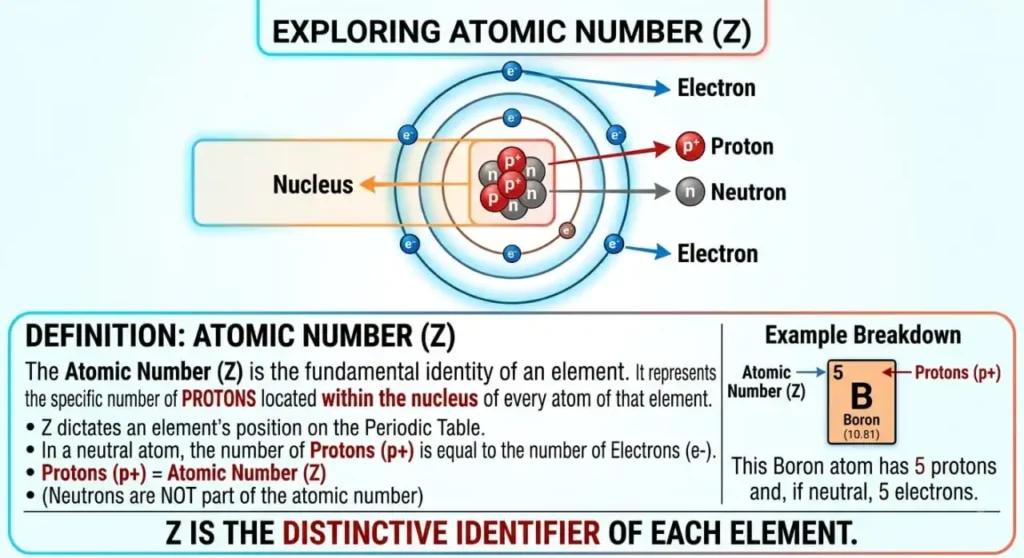
What is atomic number? The atomic number is the number of protons found in the nucleus of an atom. It is represented by Z and determines the identity of a chemical element. For example, hydrogen has an atomic number of 1 because its nucleus contains one proton, while carbon has an atomic number of 6 because it contains six protons. Every element has its own atomic number, making it a fundamental concept in chemistry and the periodic table. According to IUPAC Gold Book, atomic number is also known as the proton number
What Is Atomic Number?
Atomic number tells us how many protons are present in an atom’s nucleus. Protons have a positive electric charge, while neutrons have no charge. Electrons possess a negative charge and are found outside the nucleus. The number of protons is what makes one element different from another.
The atomic number is the number of protons in an atom’s nucleus. It is represented by Z and uniquely identifies an element. For example, carbon has atomic number 6, so every carbon atom contains six protons. The atomic number is also the number assigned to an element in the periodic table. The Royal Society of Chemistry periodic table shows hydrogen as atomic number 1, helium as 2, carbon as 6, and oxygen as 8.
How Is Atomic Number Calculated?
Atomic number is calculated by counting the number of protons in the nucleus. The basic formula is: Atomic number (Z) = Number of protons For a neutral atom, the number of protons should equal to the number of electrons. Therefore, if you know the number of electrons in a neutral atom, you can determine its atomic number. For example:
Hydrogen → 1 proton → Z = 1
Carbon → 6 protons → Z = 6
Oxygen → 8 protons → Z = 8
Sodium → 11 protons → Z = 11 However, remember that losing or gaining electrons does not change an element’s atomic number. It only changes the atom’s charge and forms an ion.
Atomic Number Tells About an Element?
The atomic number tells us the identity of an element. If an atom contains 6 protons, it is carbon. If it contains 8 protons, it is oxygen. Changing the number of protons creates a different element.
It also helps determine the electron arrangement of a neutral atom. For example, a neutral oxygen atom has eight protons and eight electrons. Its electron arrangement influences how oxygen interacts with other elements. The atomic number also provides the basis for organizing the modern periodic table. Research by physicist Henry Moseley helped establish atomic number as a fundamental property of the elements. The Royal Society of Chemistry’s history of the periodic table explains how Moseley’s X-ray work supported ordering elements by atomic number.
Atomic number and mass number describe different properties of an atom. The atomic number counts protons, while the mass number represents the total number of protons and neutrons
Property
Atomic Number
Mass Number
Symbol
Z
A
Meaning
Number of protons
Protons + neutrons
Meaning
Number of protons
Protons + neutrons
Determines element identity?
Yes
No
Example for carbon-12
6
12
The relationship can be written as: Mass number = Protons + Neutrons Therefore: Number of neutrons = Mass number − Atomic number For carbon-12, the atomic number is 6 and the mass number is 12. Therefore, it contains 6 protons and 6 neutrons. The Royal Society of Chemistry similarly explains that the number of protons determines an element’s identity, while neutron numbers can vary.
Different Elements Have the Same Atomic Number?
Number of neutrons = Mass number − Atomic number For carbon-12, the atomic number is 6 and the mass number is 12. Therefore, it contains 6 protons and 6 neutrons. The Royal Society of Chemistry similarly explains that the number of protons determines an element’s identity, while neutron numbers can vary. Different Elements Have the Same Atomic Number? No. Two different elements cannot have the same atomic number. The atomic number uniquely identifies an element because it represents the number of protons in its nucleus. For example, every carbon atom has six protons, whereas every nitrogen atom has seven. If the number of protons changes from six to seven, the atom is no longer carbon; it becomes nitrogen. Atoms of the same element can posses different numbers of neutrons. These forms are called isotopes. Their atomic number remains the same, but their mass numbers differ.
Atomic Number Importance
Atomic number is important because it helps scientists:
Identify chemical elements.
Arrange elements in the periodic table.
Determine the number of protons in an atom.
Determine electrons in a neutral atom.
Distinguish one element from another.
Understand isotopes and atomic structure.
Study periodic trends and chemical behavior. The current periodic table contains 118 officially named elements, with atomic numbers ranging from 1 for hydrogen to 118 for oganesson.
For a **neutral atom**, yes. A neutral atom has equal numbers of protons and electrons. However, ions have gained or lost electrons, so their electron number may differ from their atomic number.
No. Isotopes of the same element always have the same atomic number. They differ in their number of neutrons and therefore have different mass numbers.
Conclusion
The atomic number is the number of protons in an atom’s nucleus and is represented by Z. It uniquely identifies an element and determines its position in the periodic table. Unlike mass number, which includes both protons and neutrons, atomic number remains the same for all isotopes of an element. Understanding this concept makes it easier to learn atomic structure, isotopes, ions, and periodic trends. Want to learn more chemistry? Explore our related guides on protons, neutrons, and electrons to build a stronger understanding of atomic structure.