
Average Atomic Mass
Seeing a decimal value for an element’s mass on the periodic table can be confusing. If atoms have whole-number mass numbers, why does chlorine have an atomic mass of about 35.45 u? The reason is that most elements exist as a mixture of isotopes with different masses and natural abundances. Average atomic mass solves this problem by using a weighted average of the isotope masses. Once you know the isotope abundances and apply the simple formula, you can calculate the value accurately and understand why periodic-table masses are often decimals.
What Is Average Atomic Mass?
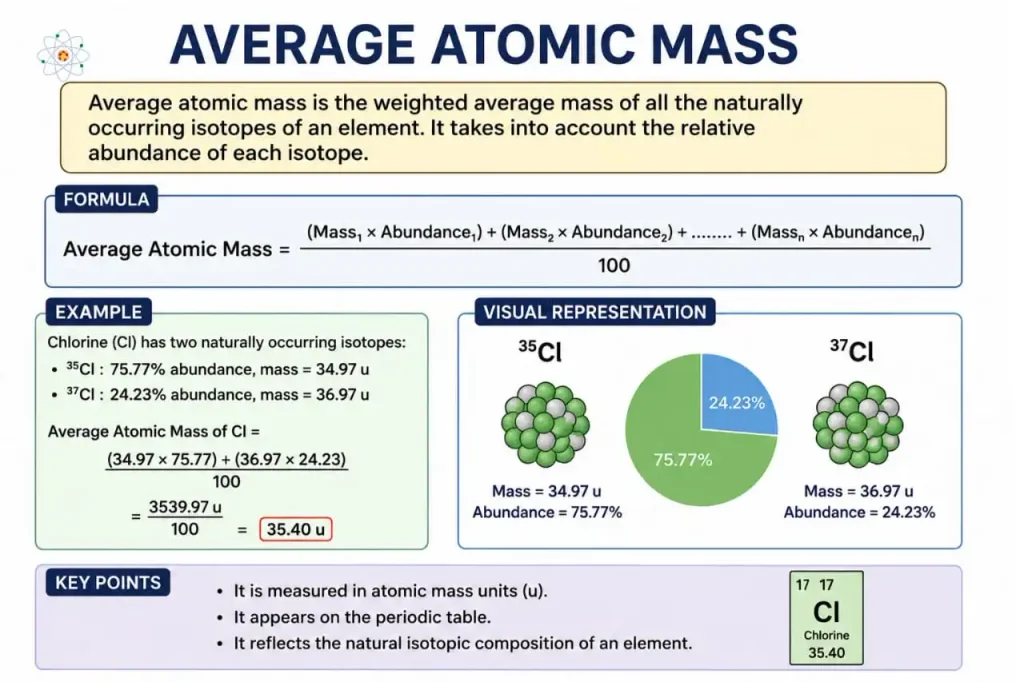
Average atomic mass is the weighted average of the masses of all the isotopes of an element that occur naturally It takes into account both the mass of each isotope and how much of it is found in nature
For example chlorine mostly exists as chlorine 35 and chlorine 37 Since chlorine 35 is more common it has a bigger impact on the number
The term is related to relative atomic mass IUPAC says relative atomic mass is the ratio of the average mass of an atom to the unified atomic mass unit
Average Atomic Mass Definition
Average atomic mass is the weighted average of the masses of an elements isotopes based on how common they are
It is usually given in unified atomic mass units u The unified atomic mass unit is based on one twelfth of the mass of a carbon 12 atom
Why Do We Use an Average
Atoms of the same element can have different numbers of neutrons These forms are called isotopes
| Isotope | Protons | Neutrons | Approx. Mass |
|---|---|---|---|
| Chlorine-35 | 17 | 18 | 35 u |
| Chlorine-37 | 17 | 20 | 37 u |
Both are chlorine because they have 17 protons Their different numbers of neutrons give them different masses
The percentage of each isotope also matters NIST provides isotope masses and isotopic compositions for the elements and explains that the relative atomic mass of an element is found by averaging the relative atomic masses of its isotopes
For more on how atomic quantities are different see Atomic Mass vs Mass Number
Average Atomic Mass Formula
The basic formula is
atomic mass Σ isotopic mass × fractional abundance
When abundance is given as a percentage
Average atomic mass [(mass₁ × % abundance₁). Mass₂ × % abundance₂). ] ÷ 100
Here each isotope contributes based on how common it’s
Average Atomic Mass Calculation
Let us calculate : the value using a simple chlorine example
Suppose an element has two isotopes
- Isotope A mass 35 u abundance 75%
- Isotope B mass 37 u abundance 25%
Use the formula
Average mass [(35 × 75). 37 × 25)] ÷ 100
= (2625 + 925) ÷ 100
= 3550 ÷ 100
= 35 5 U
So the calculated average is 35 5 u
Real isotope calculations use isotope masses and abundance values This is why the periodic table value for chlorine is about 35 45 instead of exactly 35 5 NIST has detailed data for isotope masses and abundances
How Do You Calculate the Average Mass of an Object
The idea of a mass can be used for everyday objects too The calculation depends on what is being averaged
If several objects have equal importance use the arithmetic mean
Average mass Total mass ÷ Number of objects
For example if three objects have masses of 10 g 12 g and 14 g
Average mass (10 + 12 + 14) ÷ 3
= 12 g
Atomic calculations are different because isotopes do not necessarily occur in the amounts Chemistry uses a weighted average An isotope that is more common has a bigger effect on the result
Average Atomic Mass , Mass Number, Atomic mass,Relative atomic mass
| Term | Meaning |
|---|---|
| Mass Number | Total number of protons and neutrons in one isotope. |
| Atomic Mass | Actual mass of a specific atom, usually expressed in u. |
| Average Atomic Mass | Weighted average of the masses of an element’s isotopes. |
| Relative Atomic Mass | Ratio comparing the average mass of an atom with the carbon-12 reference. |
IUPAC defines atomic mass as the rest mass of an atom in its ground state while the unified atomic mass unit is the standard unit used for atomic masses
You can also find out more about the connection between these concepts in Relative Atomic Mass
Why Average Atomic Mass Is Important ?
This value is important in chemistry for calculations involving molecules and the periodic table It allows chemists to work with an element as it naturally occurs rather than just one isotope
It is also used when calculating relative molecular mass formula mass molar mass and amounts of reactants
The values listed for elements are connected to standard atomic weights and isotope compositions IUPAC says standard atomic weights are the recommended relative atomic mass values for normal samples of elements
Common Mistakes to Avoid
1 Taking an average of isotope masses Do not add isotope masses and divide by the number of isotopes unless their abundances are equal
2 Forgetting to convert percentages If abundance is given as 75 use 0 75 when working with fractional abundance
3 Confusing number with average mass A mass number belongs to one isotope The average value represents the isotope mixture
4 Assuming every atom has the value An individual atom has the mass of its isotope The average describes the element as a mixture
Reference:
National Institute of Standards and Technology (NIST), Atomic Weights and Isotopic Compositions with Relative Atomic Masses. NIST provides isotope masses, isotopic abundances, and atomic-weight data used to determine the weighted average for an element.