
Isotopes:
Isotopes are different possible existences scenarios for a specific element. If one element can exist in more than one form then all possible forms are isotopes of that element. Look at the name isotope. Word isotope came from Greek word topos which means place. And word ISO means same. So, according to word isotopes means having same place(in periodic table).
Definition
When a specific element has more than 1 type of its existences depending on changed number of neutrons in their nucleus then all these possible exist able elements types are called isotopes. They all have same atomic number. But all have different atomic masses. And in other words all isotopes have different number of neutrons in them.
If one element has 3 isotopes then it is confirmed that all three isotopes will have same number of electrons and protons in them. But number of neutrons will be different in all of them. And mass number of each will be different from each other. Because mass number of any element is = number or protons + number of neutrons.
Example:
Isotopes of hydrogen:
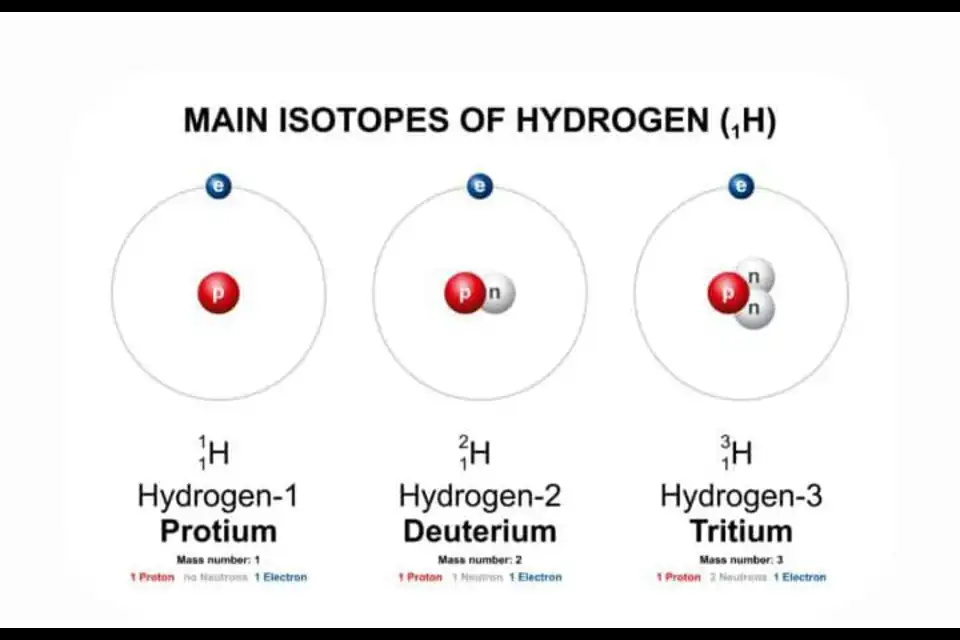
Hydrogen has 3 isotopes:
1:Protium H-1
2:Dueterium H-2
3:Tritium H-3
Protium:
Atomic number = 1
Eletctron = 1
Protons = 1
Neurtrons = 0
Mass number = 1
Abundance = 99.98% in nature is protium.
Presence: Protium is present in simple drinking water.
Deutrium:
Atomic number = 1
Electrons = 1
Protons = 1
Neurtrons = 1
Mass number = 2
Abundance= 0.014-0.015%
Presence:
Deuterium is present in heavy water. (Unable to drink).
Tritium:
Atomic number = 1
Etctrons = 1
Protons = 1
Neurtrons = 2
Mass number = 3
Abundance = very very much low.
Uses: Tritium is used in nuclear weapons and in fusion research etc.
Isotopes in periodic table:
Each element in periodic table have isotopes: All 118 elements have isotopes which are approximately.
Stable isotopes in periodic table:
stable isotopes. Half life of such isotopes is unlimited.
Example: Carbon-12 isotope etc
There are 80 stable elements in periodic table.
And these 80 elements have minimum one isotope of each.
Example:
Protium
Carbon-12 isotope
Nitrogen-14 isotope
Oxygen- 16 isotope
Properties of stable isotopes:
Nucleus of stable isotopes is also stable. It do not release any radiation and do not experience radioactive decay.
Half life:
Stable isotopes have infinite half life. Because they have not radiation releasing phenomenon.
Uses:
They are used in daily life and industry.
Effect on human body:
They are harmless for body. These are safe to use and interact with.
Existence with time:
Stable isotopes remain same with time they do not change into other elements.
Radio-active isotopes:
The isotopes which emits are releases radiations continuously and have a specific half life are called radio-active isotopes. Nucleus of radio-active isotopes is unstable. And their nucleus emits radiations to become stable. And this process is called radio-active decay.
Radiations types:
Alpha Rays:
Beta
Gamma
Duration of half life:
Duration of half life maybe from 1second to millions of years.
Radio-active isotopes decay with time and a time comes when they convert into another element.
There are 38 elements which have radio-active isotopes.
Examples:
Tritium
Carbon-14
Uranium-235
Uraium-238
Properties of Radio-active isotopes:
Unstable nuceus:
Nucleus of radioactive isotope is always unstable and it emits radiations to be stable.
Radiations:
Radioactive isotopes releases radiations which maybe alpha, beta or gamma radiations.
Half-Life:
Half life of radioactive isotopes is fixed. After half life, half of matter of specific isotope is vanished in form of radiations.
Abundance in nature:
They are found very rare in nature due to radioactivity. And decaying process.
Existence with time:
Radioactive isotopes change into other elements with passage of time. This is due to radioactive activity.
Uses:
Radioactive isotopes are used in medicine and nuclear dating etc.
They are used to kill cancer cells.
Iodine-131isotope is used in thyroid scan.