
Electronic Configuration
In this blog , we are going to learn about electronic configuration.
If you are confused about how electrons are arranged in shells, subshells, and orbitals. Don’t worry. By the end of this blog, you will be able to write the electronic configuration You will learn elements electronic configration step by step.
What is Electronic Configuration?
Electronic configuration is the arrangement of electrons in an atom around its nucleus.
Electrons are not placed randomly. They occupy different energy levels, subshells, and orbitals according to specific rules.
For example, hydrogen has only one electron, so its electronic configuration is:
1s¹
Number 1 represents the principal energy level.
The letter s represents the subshell.
And the superscript 1 tells us that there is one electron in that subshell.
Shells and Energy Levels
Before learning SPDF notation. We need to understand electron shells.
Electron shells are represented by:
n = 1, 2, 3, 4, 5, 6, 7
They can also be called:
K, L, M, N, O, P, and Q shells.
The first shell is closest to the nucleus and generally has the lowest energy.
As we move farther from the nucleus, the energy level generally increases.
Subshells: s, p, d and f
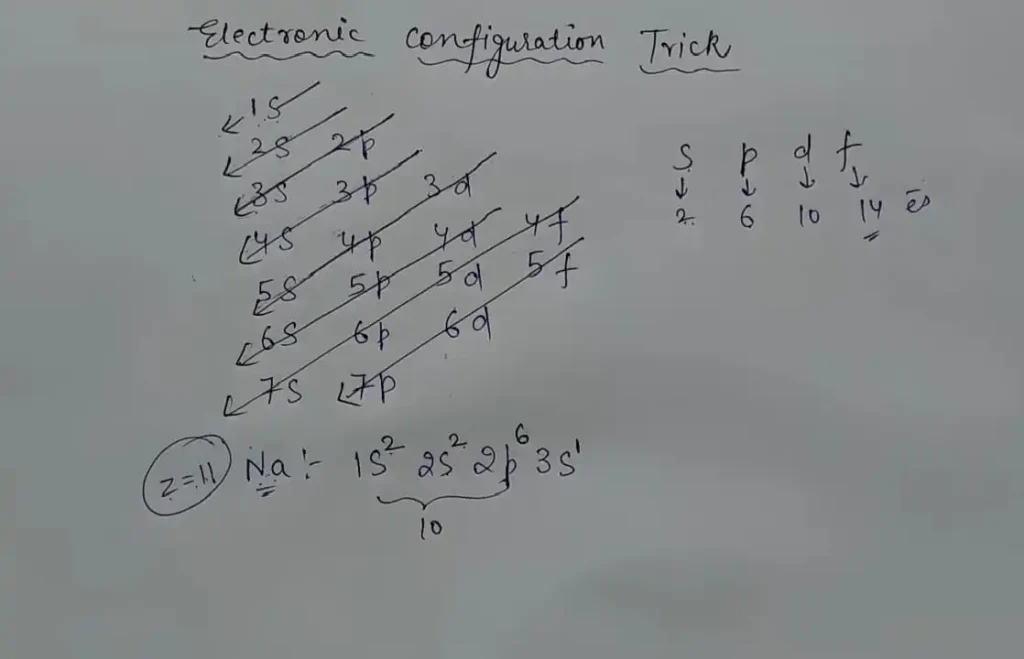
Each principal energy level contains one or more subshells.
There are four important types of subshells:
s, p, d, and f
The maximum number of electrons each subshell can hold is:
- s = 2 electrons
- p = 6 electrons
- d = 10 electrons
- f = 14 electrons
A simple way to remember this is:
2, 6, 10, 14
Why Can s Hold 2 Electrons?
“S” subshell contains one orbital.
Each orbital can contain a maximum of two electrons.
Therefore:
1 orbital × 2 electrons = 2 electrons
So, an s subshell can hold a maximum of 2 electrons.
Why Can p Hold 6 Electrons?
“P” subshell contains three orbitals.
Each orbital can contain two electrons.
Therefore:
3 × 2 = 6 electrons
So, the p subshell can hold a maximum of 6 electrons.
d and f Subshells
The d subshell contains five orbitals.
Therefore:
5 × 2 = 10 electrons
The f subshell contains seven orbitals.
Therefore:
7 × 2 = 14 electrons
So remember:
s → 2
p → 6
d → 10
f → 14
Order of Filling Electrons
Now comes the most important part.
Electrons fill orbitals according to their increasing energy.
The commonly used filling order is:
1s → 2s → 2p → 3s → 3p → 4s → 3d → 4p → 5s → 4d → 5p → 6s → 4f → 5d → 6p → 7s → 5f → 6d → 7p
You should memorize this sequence because it is very useful when writing electronic configurations.
Rules of electronic configuration
Aufbau Principle
The first rule is the Aufbau principle.
According to this principle, electrons occupy the available orbitals in order of increasing energy.
In simple words:
Lower-energy orbitals are filled before higher-energy orbitals.**
For example, the 4s orbital is filled before the 3d orbital.
That is why we write:
4s before 3d
Pauli Exclusion Principle
The second important rule is the Pauli exclusion principle.
It states that an orbital can contain a maximum of two electrons, and those electrons must have opposite spins.
So we can represent an orbital as:
↑↓
But we cannot place three electrons in one orbital.
Hund’s Rule
The third rule is Hund’s rule.
According to Hund’s rule, electrons occupy orbitals of the same energy individually before pairing occurs.
For example, the three p orbitals are filled like this first:
↑ ↑ ↑
and only then pairing begins:
↑↓ ↑ ↑
and then:
↑↓ ↑↓ ↑
This helps us correctly distribute electrons among orbitals. To understand electronic configuration examples are given below.
Electronic configuration of carbon
Carbon has atomic number 6.
Therefore, a neutral carbon atom has six electrons.
We fill them step by step:
First:
1s²
Then:
2s²
We have used four electrons.
The remaining two electrons enter the 2p subshell.
Therefore:
1s² 2s² 2p²
This is the electronic configuration of carbon.
Electronic configuration of chlorine
Chlorine has atomic number 17.
Therefore, it contains 17 electrons.
Its electronic configuration is:
1s² 2s² 2p⁶ 3s² 3p⁵
Now count the electrons:
2 + 2 + 6 + 2 + 5 = 17
Therefore, this is the correct electronic configuration of chlorine.
Noble Gas Configuration
Writing the complete configuration can sometimes be lengthy.
We can use noble gas notation to make it shorter.
For example, sodium has the complete configuration:
1s² 2s² 2p⁶ 3s¹
The first ten electrons have the same configuration as neon.
Therefore, we can write sodium as:
[Ne] 3s¹
This is called the condensed or noble gas configuration.
Important Points to Remember
Before we finish, remember these important points.
First:
s holds 2 electrons.
Second:
p holds 6 electrons.
Third:
d holds 10 electrons.
Fourth:
f holds 14 electrons.
Also remember the three important rules:
Aufbau principle — electrons fill lower-energy orbitals first.
Pauli exclusion principle — one orbital can contain a maximum of two electrons with opposite spins.
Hund’s rule — electrons occupy equal-energy orbitals singly before pairing.
Conclusion
So, electronic configuration tells us how electrons are distributed in an atom.
To write it correctly, you need to understand:
shells, subshells, orbitals, SPDF notation, and the rules of electron filling.
Once you understand the filling order and remember Aufbau, Pauli, and Hund’s rules, writing electronic configurations becomes much easier. You also can watch lecture on Electronic configuration if you need