
Relative Atomic Mass
We often see values such as 23 for sodium or 35.45 for chlorine on the periodic table. This can be confusing. Why chlorine is not simply 35 or 36 if its atoms have whole mass numbers?
Answer is relative atomic mass. It considers the different isotopes of an element and their natural abundance. Once you understand isotopes and weighted averages, the calculation becomes simple.
Definition
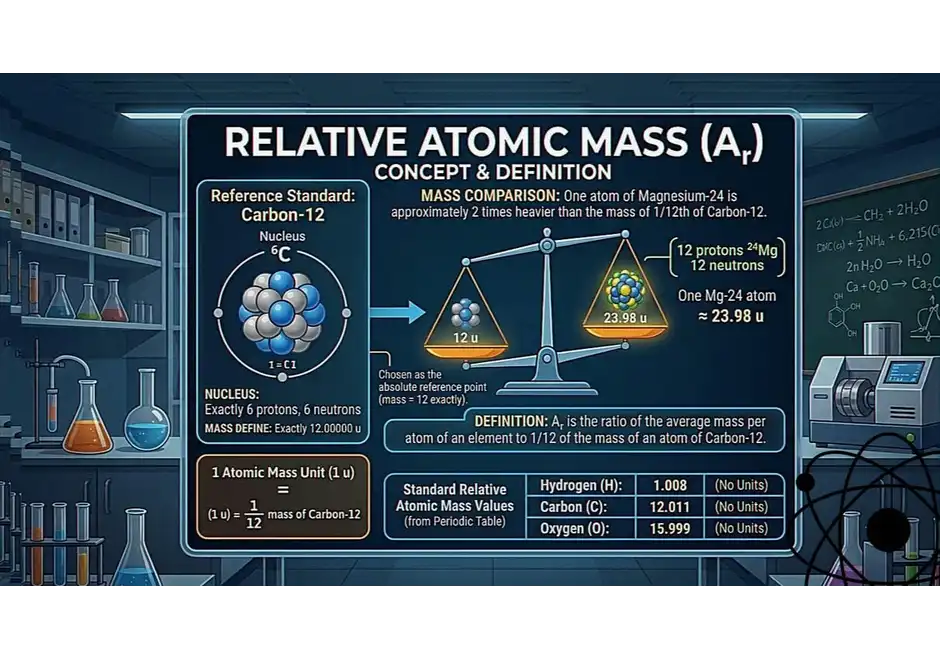
It is the weighted average mass of the atoms of an element compared with 1/12 of the mass of a carbon-12 atom.
It is a relative quantity, so it has no unit.
What Is Relative Atomic Mass?
It is the average mass of an atom of an element compared with one-twelfth of the mass of a carbon-12 atom.
IUPAC defines relative atomic mass as the ratio of the average mass of an atom to the unified atomic mass unit.
In simple words, It tells us how heavy an atom is compared with the standard reference based on carbon-12.
For example, the relative atomic mass of chlorine is about 35.45. This does not mean that every chlorine atom has a mass of 35.45. Chlorine exists mainly as different isotopes, especially chlorine-35 and chlorine-37.
Why Do Elements Have Relative atomic mass?
The main reason is isotopes.
Isotopes are atoms of the same element that have the same number of protons but different numbers of neutrons. Therefore, they have different mass numbers.
For example, chlorine has two major naturally occurring isotopes:
| Isotope | Approximate Abundance | Mass |
|---|---|---|
| Chlorine-35 (³⁵Cl) | 75% | 35 |
| Chlorine-37 (³⁷Cl) | 25% | 37 |
Because both isotopes occur naturally, the relative atomic mass of chlorine falls between 35 and 37.
This is also why the periodic table may show a decimal value instead of a whole number.
If you need to review how atomic mass relates to other atomic quantities, see Atomic Mass vs Atomic Number.
Calculation
It uses the mass of each isotope and its percentage abundance.
Formula
RAM = Σ (isotopic mass × isotopic abundance) / 100
For two isotopes, it can be written as:
Aᵣ = [(mass₁ × abundance₁) + (mass₂ × abundance₂)] / 100
If abundance is given as a decimal rather than a percentage, use:
Aᵣ = (mass₁ × abundance₁) + (mass₂ × abundance₂)
Example: Calculating Chlorine’s Relative Atomic Mass
Suppose chlorine contains:
- Chlorine-35 = 75% abundance
- Chlorine-37 = 25% abundance
Apply the formula:
Aᵣ = [(35 × 75) + (37 × 25)] / 100
Aᵣ = (2625 + 925) / 100
Aᵣ = 35.5
So, the simplified relative atomic mass of chlorine is 35.5.
Using more precise isotopic masses and abundances gives a value close to the commonly listed value of 35.45. NIST provides detailed isotope masses and isotopic compositions for the elements.
Relative Atomic Mass Mean?
It gives us an average value for an element based on its isotopes.
It does not describe the exact mass number of every atom.
For example:
- One chlorine atom may be chlorine-35.
- Another may be chlorine-37.
- It represents the weighted average of the naturally occurring isotopes.
The abundance of each isotope affects the final value. An isotope with greater abundance has a greater effect on the average.
NIST explains that the relative atomic mass of an element is obtained by averaging the relative atomic masses of its isotopes.
What Is Relative Atomic Mass and AMU?
AMU means atomic mass unit. The modern preferred name is the unified atomic mass unit, written as u.
One atomic mass unit is defined as one-twelfth of the mass of a carbon-12 atom. IUPAC gives its value as approximately 1.66054 × 10⁻²⁷ kg.
The important difference is:
| Term | Meaning |
|---|---|
| Atomic mass unit (u) | A unit used to express very small atomic masses. |
| Relative atomic mass (Aᵣ) | A ratio comparing the average atomic mass of an element with the carbon-12 reference. |
| Mass number | The total number of protons and neutrons in one atom. |
Relative atomic mass is therefore unitless, while atomic mass expressed in u has a unit.
Why Relative Atomic Mass Is Important?
It is used in many chemistry calculations. It helps determine relative molecular mass, formula mass, and the amounts of substances involved in chemical reactions.
For example, when calculating the relative molecular mass of water:
H₂O = (2 × 1.008) + 16.00
Mᵣ = 18.016
The atomic masses used in such calculations come from the relative atomic masses of the elements.
Students studying matter and particle structure can also connect this topic with States of Matter, since the same atoms and molecules form solids, liquids, and gases.
Key Points to Remember
- It is written as Aᵣ.
- It is an average based on the isotopes of an element.
- Isotopic abundance affects the final value.
- It has no unit.
- The carbon-12 atom provides the reference standard.
- The atomic mass unit (u) is a unit of atomic mass.
- Mass number is different from relative atomic mass.
- The RAM formula uses isotope masses and their abundances.
Refrences
International Union of Pure and Applied Chemistry (IUPAC). “Relative Atomic Mass.” IUPAC Compendium of Chemical Terminology (Gold Book), 5th ed., 2025. DOI: 10.1351/goldbook.R05258.
Web reference: IUPAC Gold Book – Relative Atomic Mass