Ionic Bonding:
It is one of the main types of chemical bonding. It occurs when electrons are transferred from one atom to another. This transfer produces positively and negatively charged ions. The opposite charges then attract each other and form an ionic bond. Ionic bonding is especially common between metals and nonmetals.
What Is an Ionic Bond?
An ionic bond is the electrostatic attraction between oppositely charged ions. Ionic bonding occurs through electrostatic attraction between oppositely charged ions, typically formed when electrons are transferred from one atom to another. Royal Society of Chemistry – Ionic Bonding.
A positive ion is called a cation, while a negative ion is called an anion. According to IUPAC, ionic bonding is associated with atoms that have a large difference in electronegativity.
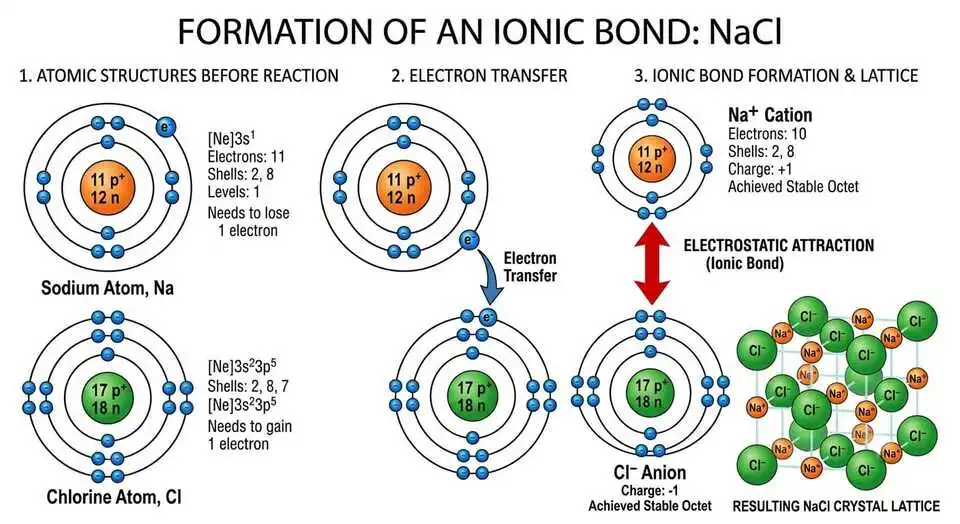
A simple example is sodium chloride (NaCl). Sodium loses an electron and becomes Na⁺. Chlorine gains that electron and becomes Cl⁻. The attraction between Na⁺ and Cl⁻ forms an ionic bond.
Cation and Anion
Ions are atoms or groups of atoms that have an electrical charge. They form when electrons are lost or gained.
Cation
A cation is a positively charged ion. It forms when an atom loses one or more electrons.
For example:
Na → Na⁺ + e⁻
Sodium loses one electron and forms a sodium cation with a +1 charge.
Anion
An anion is a negatively charged ion. It forms when an atom gains one or more electrons.
For example:
Cl + e⁻ → Cl⁻
Chlorine gains one electron and becomes a chloride anion.
Valence Electrons and Valence Shell
Valence electrons are the electrons present in the outermost occupied shell of an atom. They play an important role in chemical bonding.
The outermost occupied electron shell is called the valence shell. Atoms often gain or lose valence electrons to reach a more stable electron arrangement.
For example, sodium has one valence electron. It can lose this electron easily and form Na⁺. Chlorine has seven valence electrons and can gain one electron to form Cl⁻.
Understanding valence electrons also helps explain why elements form different ions.
Valency
Valency describes the combining capacity of an atom. It is commonly related to the number of electrons an atom loses, gains, or shares during bonding.
For example, sodium has a valency of 1 because it loses one electron. Magnesium has a valency of 2 because it loses two electrons.
Valency of Oxygen
The valency of oxygen is 2. Oxygen has six valence electrons and usually gains two electrons to complete its outer shell.
Therefore:
O + 2e⁻ → O²⁻
The oxygen ion is called the oxide ion.
Ionic Bond Formation
Ionic bond formation usually involves a metal and a nonmetal. The metal loses electrons, while the nonmetal gains electrons. This creates oppositely charged ions.
For example, magnesium has two valence electrons. Chlorine needs one electron to complete its outer shell. Therefore, one magnesium atom transfers two electrons to two chlorine atoms.
Mg → Mg²⁺ + 2e⁻
2Cl + 2e⁻ → 2Cl⁻
The resulting ions attract each other and form MgCl₂.
Ionic Bond and Electronegativity
Electronegativity is the ability of an atom to attract electrons toward itself.
Ionic bonding is generally associated with a large electronegativity difference between two atoms. Metals usually have lower electronegativity and tend to lose electrons. Nonmetals usually have higher electronegativity and tend to gain electrons.
However, bonding is not always completely ionic or completely covalent. IUPAC notes that it is often more useful to consider the ionic character of a bond.
Ionic Bond Structure
Ionic compounds do not usually exist as separate molecules like many covalent substances. Instead, their ions form an organized crystal lattice. Positive and negative ions are arranged in a repeating three-dimensional pattern.
For example, solid sodium chloride contains a regular arrangement of Na⁺ and Cl⁻ ions. The strong electrostatic attractions throughout this structure help explain many of its physical properties. ([Chemistry LibreTexts][3])
Properties of Ionic Bonds and Ionic Compounds
Ionic compounds commonly have these properties:
- High melting and boiling points
- Hard and crystalline structures
- They are usually brittle
- They are often soluble in water
- They conduct electricity when molten or dissolved in water
- They do not usually conduct electricity well as solid crystals
These properties result from the strong attractions between oppositely charged ions in the crystal lattice.
To understand the physical states in which substances exist, you can also read our guide to States of Matter.
Ionic Compounds
A compound made of positive and negative ions is called an ionic compound. The total positive charge and total negative charge must balance, so the compound is electrically neutral.
Common examples include:
| Ionic compound: | Formula: |
| Sodium chloride | NaCl |
| Magnesium oxide | MgO |
| Calcium chloride | CaCl₂ |
| Sodium oxide | Na₂O |
| Magnesium chloride | MgCl₂ |
Ionic Bond Examples
Sodium chloride (NaCl): Sodium loses one electron and chlorine gains one electron.
Magnesium oxide (MgO): Magnesium loses two electrons and oxygen gains two electrons.
Calcium chloride (CaCl₂): Calcium loses two electrons, while two chlorine atoms each gain one electron.
These examples show how electron transfer creates ions and how charge balance determines the formula of an ionic compound.
When studying atoms and their composition, it is also useful to understand the difference between atomic mass and atomic number. See our guide on Atomic Mass vs Atomic Number.
Conclusion
Ionic bonding occurs through the transfer of electrons and the attraction between oppositely charged ions. Metals generally form cations, while nonmetals form anions. Valence electrons, valency, and electronegativity all help explain this process. Ionic compounds form crystal lattices and usually have high melting points, hard structures, and other characteristic properties. Understanding ionic bonding provides a strong foundation for learning chemical compounds and reactions.