Have you ever wondered why iron rusts, how a battery produces electricity, or why some substances react by exchanging electrons? These processes look different, but they have one thing in common: electrons move from one chemical species to another. Understanding this movement makes redox chemistry much easier.
The problem for many students is that oxidation and reduction are often taught as two separate ideas. In reality, they are closely connected. When one species loses electrons, another gains them. By tracking oxidation numbers, we can identify what is oxidized, what is reduced, and which substances act as oxidizing or reducing agents.
What Is a Redox Reaction?
Redox reaction is a chemical reaction in which oxidation and reduction occur together.
2Na + Cl₂ → 2NaCl
Sodium loses electrons and forms Na⁺, while chlorine accepts those electrons and forms Cl⁻. Sodium is therefore oxidized, and chlorine is reduced. Oxidation and reduction are linked because electrons lost by one species must be accepted by another.
Oxidation and Reduction
Oxidation
Oxidation is the loss of electrons by an atom, ion, or molecule.
Na → Na⁺ + e⁻
Sodium loses one electron, so it is oxidized. A common memory aid is OIL: Oxidation Is Loss.
For example:
Fe²⁺ → Fe³⁺ + e⁻
Iron changes from +2 to +3, so it has been oxidized.
Reduction
Reduction is the gain of electrons by an atom, ion, or molecule.
Cl₂ + 2e⁻ → 2Cl⁻
Chlorine gains electrons and is reduced. The memory aid GER, Gain of Electrons is Reduction, can help remember this idea.
| Oxidation | Reduction |
|---|---|
| Loss of electrons | Gain of electrons |
| Oxidation number increases | Oxidation number decreases |
| Electrons are donated | Electrons are accepted |
| Species becomes more positive | Species becomes more negative |
| Example: Fe²⁺ → Fe³⁺ + e⁻ | Example: Cu²⁺ + 2e⁻ → Cu |
| OIL: Oxidation Is Loss | GER: Gain of Electrons is Reduction |
| Reducing agent undergoes oxidation | Oxidizing agent undergoes reduction |
Oxidation Numbers
An oxidation number, or oxidation state, is a number assigned to an atom to describe its apparent electron loss, gain, or sharing in a compound.
Rules for Assigning Oxidation Numbers
Some basic rules are especially useful:
- An element in its free form has an oxidation number of 0, such as Na, H₂, O₂, and Cl₂.
- A simple ion has an oxidation number equal to its charge. For example, Na⁺ = +1.
- Oxygen is usually −2.
- Hydrogen is usually +1 when bonded to nonmetals.
- The oxidation numbers in a neutral compound add up to 0.
- In a polyatomic ion, their total equals the charge of the ion.
Assigning Oxidation Numbers: Example
Find the oxidation number of sulfur in H₂SO₄.
Let sulfur = x.
2(+1) + x + 4(−2) = 0
2 + x − 8 = 0
x = +6
Therefore, sulfur has an oxidation number of +6 in H₂SO₄.
Recognizing Redox Reactions
One reliable way to recognize a redox reaction is to check whether oxidation numbers change.
If an oxidation number increases, it means oxidation has occurred. If it decreases, it means reduction has occurred.
2Mg + O₂ → 2MgO
Magnesium changes from 0 to +2, so it is oxidized. Oxygen changes from 0 to −2, so it is reduced. Since both processes occur together, the reaction is a redox reaction.
If oxidation numbers do not change, the reaction is generally not a redox reaction.
Use of Oxidation Numbers to Identify Oxidation and Reduction
Sometimes a chemical equation does not show electrons directly. In such cases, oxidation numbers provide a simple way to follow the changes.
Zn + CuSO₄ → ZnSO₄ + Cu
Zinc changes from 0 to +2:
Zn: 0 → +2
Its oxidation number increases, so zinc is oxidized.
Copper changes from +2 to 0:
Cu: +2 → 0
Its oxidation number decreases, so copper is reduced.
Oxidising Agents and Reducing Agents
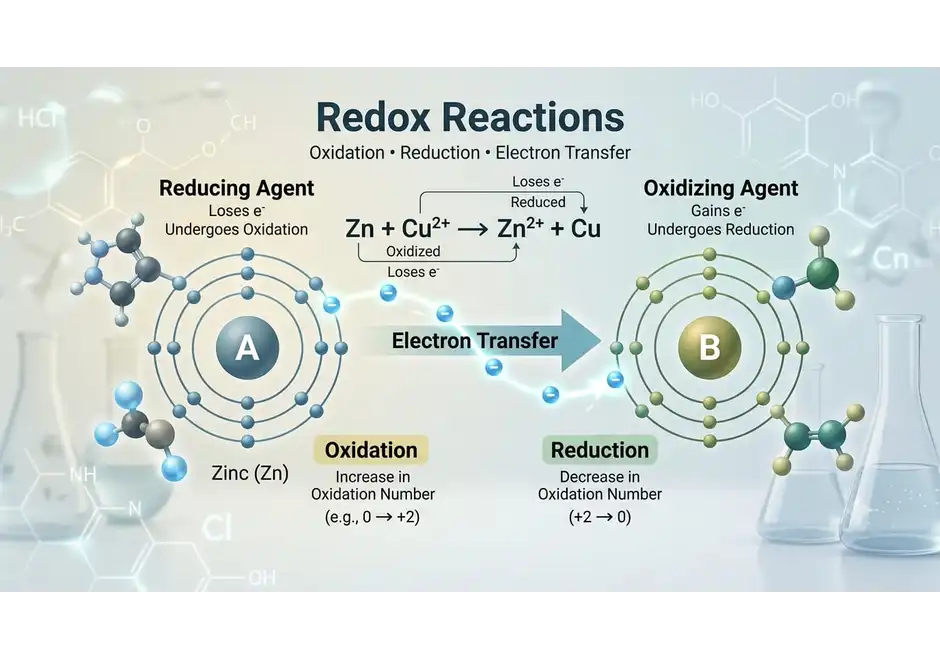
Oxidising Agent
An oxidising agent is a substance that causes another substance to lose electrons. It accepts those electrons and is itself reduced.
Zn + Cu²⁺ → Zn²⁺ + Cu
Cu²⁺ accepts electrons from zinc. Therefore, Cu²⁺ is the oxidising agent.
Remember:
Oxidising agent → accepts electrons → is reduced.
Reducing Agent
A reducing agent causes another substance to gain electrons. It donates electrons and oxidized itself .
In the same reaction, zinc gives electrons to Cu²⁺. Therefore, zinc is the reducing agent.
Remember:
Reducing agent → donates electrons → is oxidized.
The names can feel confusing at first. The key is to focus on what the agent does to the other substance, not on what happens to the agent itself.
Oxidants and Reductants
Oxidant is another term for an oxidising agent. It accepts electrons and undergoes reduction.
A reductant is another term for a reducing agent. It donates electrons and undergoes oxidation.
Disproportionation Reactions
In some reactions, the same element is both oxidized and reduced. This is called a disproportionation reaction.
Hydrogen peroxide provides an example:
2H₂O₂ → 2H₂O + O₂
Oxygen in H₂O₂ has an oxidation number of −1. In H₂O, oxygen becomes −2, so it is reduced. In O₂, oxygen becomes 0, so it is oxidized.
Cl₂ + 2NaOH → NaCl + NaOCl + H₂O
Chlorine starts at 0. In NaCl it becomes −1, so it is reduced. In NaOCl it becomes +1, so it is oxidized.
Balancing Redox Equations
Redox equations must obey conservation of atoms and, for ionic equations, conservation of charge. Two common methods are the oxidation-number method and the half-reaction method.
With the oxidation-number method, first identify the elements whose oxidation numbers change. Then compare the increase and decrease and choose coefficients so that electron loss equals electron gain. Finally, balance the remaining atoms and check the equation.
The half-reaction method is useful for more complicated ionic reactions because oxidation and reduction are balanced separately before being combined.
Real-Life Applications of Redox Reactions
Batteries
Batteries produce electrical energy through controlled oxidation and reduction. One material releases electrons while another accepts them, allowing electrons to flow through an external circuit.
Rusting
Rust forms when iron is oxidized in the presence of oxygen and moisture. This is why exposed iron objects gradually develop a reddish-brown coating.
Respiration
During cellular respiration, food molecules are oxidized through a series of reactions. These processes help cells release and use energy.
Photosynthesis
Photosynthesis also involves redox changes. Water is oxidized, while carbon dioxide is reduced as plants produce organic compounds.
Bleaching and Disinfection
Many bleaching and disinfecting substances work because of their oxidizing ability. These reactions show how redox chemistry affects everyday life in ways we often do not notice.
Redox reactions key points
Redox reactions become much easier once electron movement and oxidation numbers are connected.
- Oxidation means loss of electrons.
- Reduction means gain of electrons.
- An increase in oxidation number indicates oxidation.
- A decrease in oxidation number indicates reduction.
- An oxidising agent accepts electrons and is reduced.
- A reducing agent donates electrons and is oxidized.
- Oxidants are electron acceptors, while reductants are electron donors.
- Oxidation and reduction occur together in a redox process.
- Oxidation numbers help identify what has changed during a reaction.
- Some reactions, such as hydrogen peroxide decomposition, involve both oxidation and reduction of the same element.
Refrences
Useful for explaining redox reactions, electron transfer, oxidation numbers, and balancing redox equations.
Chemistry LibreTexts: Oxidation and Reduction