
Atom
An atom is the fundamental building block of all matter. Everything in the universe, including the air we breathe, the water we drink, the food we eat, and even our own bodies, is made up of atoms. In simple words, an atom is the smallest unit of an element that retains all of its chemical properties. Although atoms are incredibly tiny and cannot be seen with the naked eye, they play a vital role in chemistry, physics, biology, medicine, industry, and modern technology.
First of all, understanding the structure of an atom is essential for learning basic chemistry because every chemical reaction involves atoms. Moreover, atoms combine to form molecules and compounds, which make up all living and non-living things. For example, water (H₂O), carbon dioxide (CO₂), and common salt (NaCl) are all formed when atoms chemically bond together.
The word atom comes from the Greek word atomos, meaning “indivisible.” However, modern science has shown that atoms are made up of even smaller particles called protons, neutrons, and electrons. Therefore, studying atoms helps us understand the behavior of matter, chemical elements, and the periodic table.
What Is an Atom?
An atom is the smallest unit of an element that retains the chemical properties of that element and can participate in chemical reactions. Every chemical element on the periodic table consists of atoms. For example, a hydrogen atom always contains one proton, while a carbon atom always contains six protons.
Furthermore, atoms are electrically neutral because they contain equal numbers of protons and electrons. However, atoms can gain or lose electrons to form ions, which play an important role in chemical reactions.
Atoms join together by forming chemical bonds, creating molecules and various chemical compounds. As a result, complex substances such as proteins, plastics, medicines, and minerals are formed. Without atoms, matter could not exist.
Structure of an Atom
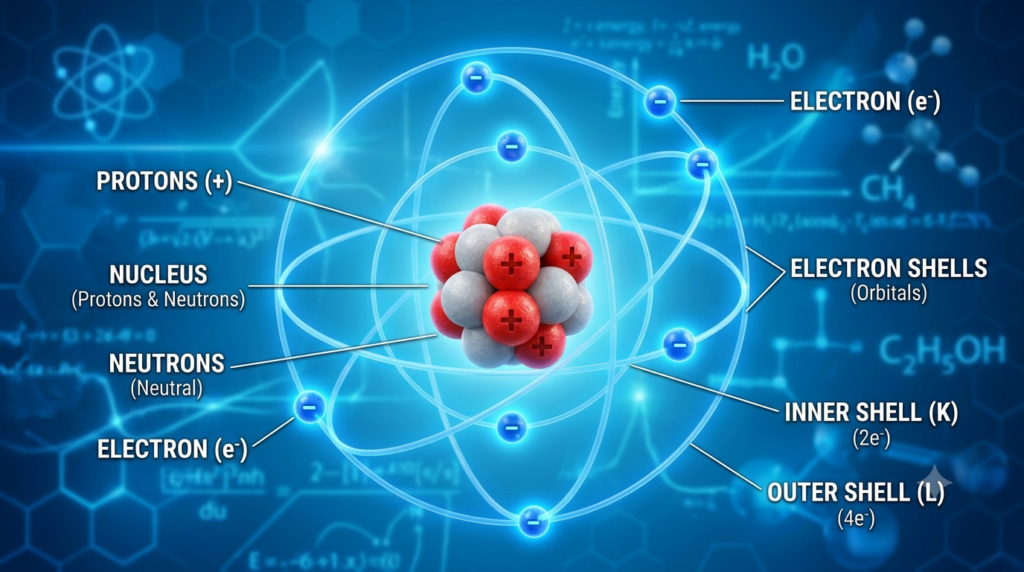
The atomic structure consists of three major subatomic particles:
Protons
Neutrons
Electrons
These particles work together to determine the physical and chemical properties of every element.
Protons
Protons are positively charged particles found inside the atomic nucleus.
Properties of Protons
Positive charge (+1)
Located inside the nucleus
Its mass is nearly equal to 1 amu (atomic mass unit).
Determine the identity of an element
For example, carbon always contains six protons, while oxygen contains eight protons. Therefore, changing the number of protons changes the element itself.
Neutrons
Neutrons are neutral particles located in the nucleus alongside protons.
Properties of Neutrons
No electrical charge
Located inside the nucleus
Mass nearly equal to a proton
Increase atomic mass and nuclear stability
Moreover, atoms of the same element may contain different numbers of neutrons. These different forms are known as isotopes.
Electrons
Electrons are negatively charged particles that move around the nucleus in different electron shells or energy levels.
Properties of Electrons
Negative charge (-1)
Extremely small mass
Responsible for chemical bonding
Occupy electron shells around the nucleus
Furthermore, the arrangement of electrons determines how an atom reacts with other atoms. As a result, electrons control the formation of chemical compounds.
Atomic Number
The atomic number is the number of protons present inside the nucleus of an atom.
In other words, the atomic number identifies the element.
| Element | Atomic Number |
| Hydrogen | 1 |
| Lithium | 3 |
| Carbon | 6 |
| Oxygen | 8 |
| Sodium | 11 |
Therefore, every element has its own unique atomic number.
Atomic Mass (Mass Number)
Mass number refers to the combined total of protons and neutrons within the nucleus of an atom.
Formula
Mass Number = Protons + Neutrons
Example
Carbon-12
Protons = 6
Neutrons = 6
Mass Number = 12
Consequently, scientists use mass numbers to identify different isotopes of an element.
Bohr Model of the Atom
In 1913, Danish physicist Niels Bohr introduced the Bohr Model to explain the arrangement of electrons within an atom.
According to Bohr’s Atomic Model:
Electrons move around the nucleus in fixed circular paths called electron shells.
Each shell has a fixed amount of energy.
Electrons cannot exist between energy levels.
Electrons absorb or release energy while moving between shells.
Although the Bohr model cannot fully explain all atoms, it remains one of the most important models in basic chemistry education.
Bohr’s Laws (Postulates)
Bohr proposed four important postulates:
Electrons move around the nucleus in fixed energy levels known as orbits
Each orbit possesses a fixed amount of energy.
Electrons do not lose energy while moving in stable orbits.
Electrons emit or absorb energy while jumping between energy levels.
Therefore, these postulates successfully explain the atomic spectrum of hydrogen.
Valence Electrons
Valence electrons are the electrons located in the outermost energy level of an atom.
These electrons determine:
Chemical properties
Bond formation
Reactivity
Compound formation
For example:
Sodium has 1 valence electron.
Carbon has 4 valence electrons.
Oxygen has 6 valence electrons.
Moreover, atoms become stable by gaining, losing, or sharing valence electrons during chemical reactions.
Valence Number (Valency)
The valence number, also known as valency, is the combining capacity of an atom. In simple words, it describes how many electrons an atom can gain, lose, or share to form a chemical bond. Therefore, valency helps scientists predict the chemical formulas of compounds and understand how elements react with one another.
Examples of Valency
Hydrogen = 1
Oxygen = 2
Carbon = 4
Sodium = 1
Lithium = 1
Furthermore, elements with similar valency often have similar chemical properties. For example, sodium and lithium both belong to Group 1 of the periodic table and have a valency of one.
Isotopes
Isotopes are atoms of the same element that contain the same number of protons but different numbers of neutrons. As a result, isotopes have the same atomic number but different mass numbers
Examples of Isotopes
Hydrogen has three naturally known isotopes:
Protium (¹H)
Deuterium (²H)
Tritium (³H)
Similarly, carbon has several isotopes, including Carbon-12, Carbon-13, and Carbon-14.
Uses of Isotopes
Isotopes have many practical applications, including:
Medical diagnosis
Cancer treatment
Archaeological dating
Scientific research
Industrial testing
Food preservation
Moreover, radioactive isotopes are widely used in hospitals to diagnose and treat various diseases.
Ions
An ion is an atom or a group of atoms that has a net electric charge due to the gain or loss of electrons.
Positive Ions (Cations)
Positive ions are produced when atoms lose one or more electrons.
Example
Na → Na⁺ + e⁻
Negative Ions (Anions)
Negative ions are formed when atoms gain electrons.
Example
Cl + e⁻ → Cl⁻
Therefore, ions play an essential role in chemical reactions, batteries, human body functions, and industrial processes
Atomic size
Distance between the nucleus and valence electrons
Periodic Trend
Increases from left to right across a period.
Decreases from top to bottom in a group.
For example, fluorine is the most electronegative element in the periodic table. Consequently, it forms highly polar chemical bonds with many other elements.
Hydrogen Atom
Hydrogen is the lightest and simplest element in the periodic table.
Properties
Atomic Number = 1
One proton
One electron
One valence electron
Hydrogen is also the most abundant element found throughout the universe. It is widely used in fuel cells, fertilizer production, petroleum refining, and the future development of clean energy technologies.
Carbon Atom
Carbon is a vital element that plays a fundamental role in supporting life on Earth.
Properties
Atomic Number = 6
Four valence electrons
Because carbon can form four covalent bonds, it creates millions of compounds, including proteins, carbohydrates, plastics, fuels, medicines, and DNA. Therefore, carbon is known as the backbone of organic chemistry.
Oxygen Atom
Oxygen is a vital element required by living organisms for survival.
Properties
Atomic Number = 8
Six valence electrons
Oxygen supports respiration and combustion. Moreover, it makes up approximately 21% of Earth’s atmosphere and is a key component of water (H₂O).
Sodium Atom
Sodium is a soft, highly reactive metal belonging to Group 1 of the periodic table.
Properties
Atomic Number = 11
One valence electron
Because sodium reacts vigorously with water, it is usually stored under oil. Furthermore, sodium combines with chlorine to produce sodium chloride (NaCl), commonly known as table salt.
Lithium Atom
Lithium is the lightest metal and one of the most useful elements in modern technology.
Properties
Atomic Number = 3
One valence electron
Today, lithium is widely used in rechargeable batteries, electric vehicles, mobile phones, laptops, ceramics, and certain medicines. As a result, lithium has become one of the most valuable industrial elements
Applications of Atoms
Atoms in Medicine
Atomic science has revolutionized modern medicine. Radioactive isotopes are used in medical imaging, cancer treatment, sterilization of medical equipment, and disease diagnosis. Consequently, millions of patients benefit from atomic technology every year.
Atoms in Industry
Industries use atomic science for quality control, material testing, chemical manufacturing, and detecting leaks in pipelines. Moreover, radioactive tracers help engineers inspect equipment without causing damage
Atoms in Energy Production
Nuclear power plants generate electricity by splitting heavy atoms such as uranium in a process called nuclear fission. Therefore, nuclear energy provides a reliable and low-carbon source of electricity for many countries.
Atoms in Manufacturing
Atomic science has made it possible to develop stronger metals, semiconductors, electronic devices, plastics, ceramics, and advanced materials. As a result, modern smartphones, computers, and medical equipment are more efficient and reliable.
Atoms in Agriculture
Atomic technology improves crop production, food preservation, soil fertility studies, and irrigation systems. Furthermore, scientists use isotopes to develop disease-resistant crops and increase agricultural productivity.
Importance of Atoms
Atoms are the foundation of chemistry and all branches of science. Without atoms, matter would not exist. Moreover, understanding atoms helps scientists explain chemical reactions, develop new medicines, improve industrial processes, generate electricity, and create advanced technologies. Overall, the study of atoms has transformed modern civilization and continues to drive scientific innovation.
Conclusion
In conclusion, the atom is the smallest unit of an element and the fundamental building block of all matter. Every atom consists of protons, neutrons, and electrons, which determine its structure and chemical behavior. Furthermore, concepts such as atomic number, atomic mass, Bohr model, valence electrons, valency, isotopes, ions, and electronegativity help explain how atoms interact to form molecules and compounds. Finally, the applications of atoms in medicine, industry, energy production, manufacturing, and agriculture demonstrate their importance in science and everyday life. By understanding the structure of the atom and the principles of atomic theory, students build a strong foundation for learning chemistry and exploring the fascinating world of science.
Frequently Asked Questions (FAQs)
Atom
I
2 Replies to “What Is an Atom? Structure, Protons, Electrons, Isotopes, and Applications”