Molecule and compound
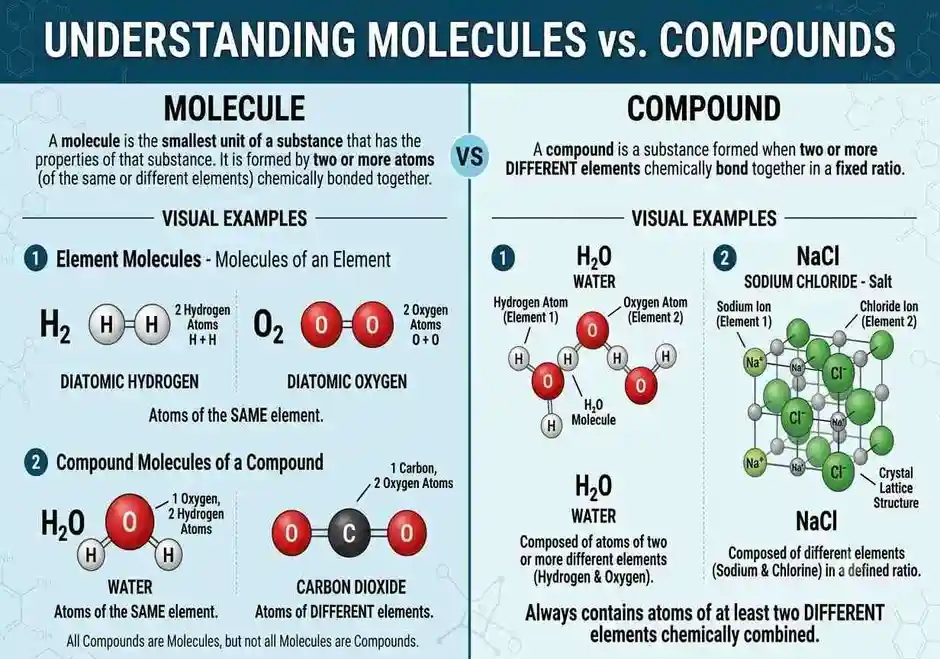
Molecule is defined as a group of two or more atoms that are bonded together by intra-molecular forces and can exist independently. These atoms can be of the same element or different elements. In contrast, a compound is a specific type of molecule that is made up of two or more different types of atoms combined in a fixed ratio.
The defining feature of a compound is this fixed proportion, which gives each compound its unique chemical identity. While all compounds are molecules because they consist of bonded atoms that can exist freely, not all molecules are compounds because some are formed from atoms of only one element. Therefore, the main distinction lies in atomic composition and ratio.
Molecules:
Single independently existable group of more than 2 atoms is called molecule.
Molecule can exist independently.
Molecule can be made up of same or different type of atoms.
Example:
Two atoms of oxygen form O2 and this is a molecule. It exist in gas form independently.
H2O water is also a moelcule. It is made up of two different types of atoms. Two atoms of hydrogen H and one atom of oxygen O form H2O.
Requirements for a molecule:
More than 2 atoms should be bonded.
Resulting specie can exist freely. For example O2 is made up of two oxygen atom and if it can exist freely it is a molecule.
There is no need for atoms to bonded in fixed ration.
Bonding in Molecule:
Molcule is formed due to intera-molecular forces between atoms.
Intra molecular forces: Strong forces present among difference atoms due to sharing of electrons between them. These sharings maybe be partial sharing as in covalent bond.
These sharings also maybe complete transfer of electron pair or electron from one donor species(atom) to another atom.
There is no inter-molecular forces inside a single molecule. But two or more than two molecules are linked to each other by inter-molecular forces.
Inter-molecular forces:
Inter-molecular forces are weak forces as compared to intra-molecular forces. These forces are not due to sharing of electrons in any sense.
Hydrogen bonding (in water). And dipole-dipole forces etc.
Intera-molecular forces:
Intra-molecular forces are very strong forces. These are due to sharing of electrons between two atoms. For example double bond between two O oxygen atoms is covalent bond which is a strong intra-molecular force. O=O. = is a double bond and it is intramolecular force.
State of molecules(solid, liquid or gas):
State of molecules in which they will exist depends on inter-molecular forces between them.
If forces among molecules are very weak then they will exist in gas form.
If forces among molecules are moderate enough to make them liquid state at room temperature then they will exist in liquid form.
If forces among molecules are very strong then these molecules will exist in solid form as bulk.
Gas form molecules:
O2 is a molecule which exist in gas form.
It consist of 2 oxygen atoms which are covalently bonded. O=O.
There is a double bond present in two oxygen atoms.
When more than two O2 atoms are combined then inter-molecular forces will be created and each O2 will attract other O2 but with very weak forces. So these O2 bulk molecules together are present in gas form.
Liquid form molecules:
H2O water is a molecule and it exist in liquid form. Because of inter-molecular forces. There is hydrogen bonding among different water molecules. These are strong enough forces to make water molecules behave as liquid at room temperature.
Solid form molecules:
When inter-molecular forces between many molecules are very strong then it will behave as solid. For example ice, iodine I2 etc.
Molecule and compound
Compound :
When two or more than two atoms are combined by intra-molecular forces in a fixed ratio then this forming independent specie is called a compound.
Each compound has its own identity and this identity is due to fixed ratio.
Major difference between compound and molecule is that there should be fixed ratio between bonding atoms to be compound. And molecule do not need any fixed ratio.
Requirements for compound:
Two or more than two atoms.
These atoms are bonded by intra-molecular forces.
These atoms should be mixed in a fixed ratio. i.e Water only forms when two H hydrogen and on O oxygen atom combines.
Fixed ratio of water:
H : O
2 atoms : 1 atom
If ratio is not fixed then compound will not form. i.e H3O cannot be water.
States of compound: (Gas, Liquid, Solid)
Gas state compounds:
Such compound have weak inter-molecular forces.
CO2. is a gas compound and is present in exhaled air.
SO2 is also a gas which is released from burning of coal.
NH3 is also a gas which is used in fertilizers.
Liquid state compounds:
Liquid state compounds have much stronger inter-molecular than gas form compounds. But these are weaker than solid state compound’s forces.
H2O is a liquid compound. Due to hydrogen bonding which is a strong force between two water molecules.
HCL. hydrochloric acid is also a liquid at room temperature due to stronger inter-molecular forces.(dipole-dipole forces).
Solid State compounds:
Such compounds have very strong inter-molecular and intra-molecular forces. Due to this reason a compound behave as solid at room temperature.
NaCL table salt or sodium chloride is a solid compound due to ionic bond.
Sugar is also solid compound.
Golden Rule:
Intra molecular forces makes the molecule or compound.
And inter molecular forces decides the state of that specific molecule or compound.
If you want to enhance your knowledge you can read following topics.
FAQ
Molecule and compound
Conclusion
A molecule consists of two or more atoms chemically bonded together, while a compound contains atoms of two or more different elements in a definite composition. Understanding this difference makes it easier to study chemical formulas, bonding, and chemical reactions. IUPAC Gold Book