Discover the five main branches of chemistry with simple definitions, real-life examples, and
practical applications in this beginner-friendly guide.
Branches of Chemistry
Have you ever wondered how medicines are made, why food changes when it’s cooked, or how
scientists test water for pollution? Although these seem like different topics, they’re all
connected through chemistry.
Chemistry is a vast field of science. Because it covers so many areas, scientists divide it into
different branches. Each branch focuses on a specific part of matter and chemical reactions,
helping us understand the world in a more organized way.
Let’s explore the main branches of chemistry in a simple and interesting way.
What Are the Branches of Chemistry?
Branches of chemistry are different areas of study that focus on specific types of substances,
reactions, or chemical processes.
The five main branches of chemistry are:
● Organic Chemistry
● Inorganic Chemistry
● Physical Chemistry
● Analytical Chemistry
● Biochemistry
Each one has its own importance and real-world applications.
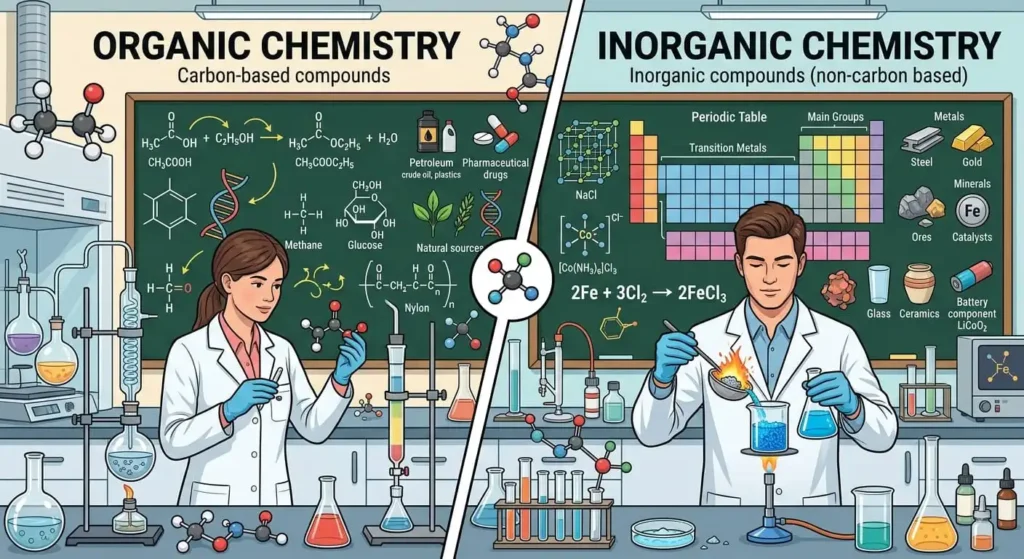
Organic Chemistry
Organic chemistry is the study of carbon-containing compounds. Since carbon forms millions of
different compounds, this is one of the largest branches of chemistry.
Real-Life Examples
● Medicines
● Plastics
● Petrol and diesel
● Cosmetics
● Soap and detergents
Think about your smartphone case or your favorite shampoo. Both are made using organic
compounds.
Where Is Organic Chemistry Used?
● Pharmaceutical industry
● Agriculture
● Cosmetics
● Food industry
● Plastic manufacturing
Inorganic Chemistry
Inorganic chemistry studies substances that generally do not contain carbon, such as metals,
minerals, salts, and crystals.
These substances are everywhere around us.
Real-Life Examples
● Table salt
● Iron
● Gold
● Cement
● Glass
For example, the steel used to build bridges and buildings is developed using principles of
inorganic chemistry.
Where Is Inorganic Chemistry Used?
● Construction
● Mining
● Electronics
● Manufacturing
● Metal industries
Physical Chemistry
Physical chemistry explains how and why chemical reactions happen. It combines chemistry
with physics to understand energy, temperature, pressure, and the behavior of atoms and
molecules.
Imagine boiling water. Physical chemistry helps explain why water changes from a liquid into
steam and how heat affects that process.
● Applications of Physical Chemistry
● Battery technology
● Renewable energy
● Fuel production
● Material science
● Nanotechnology
Analytical Chemistry
Have you ever wondered how scientists know whether drinking water is safe or how doctors
detect diseases through blood tests? The answer lies in Analytical Chemistry.
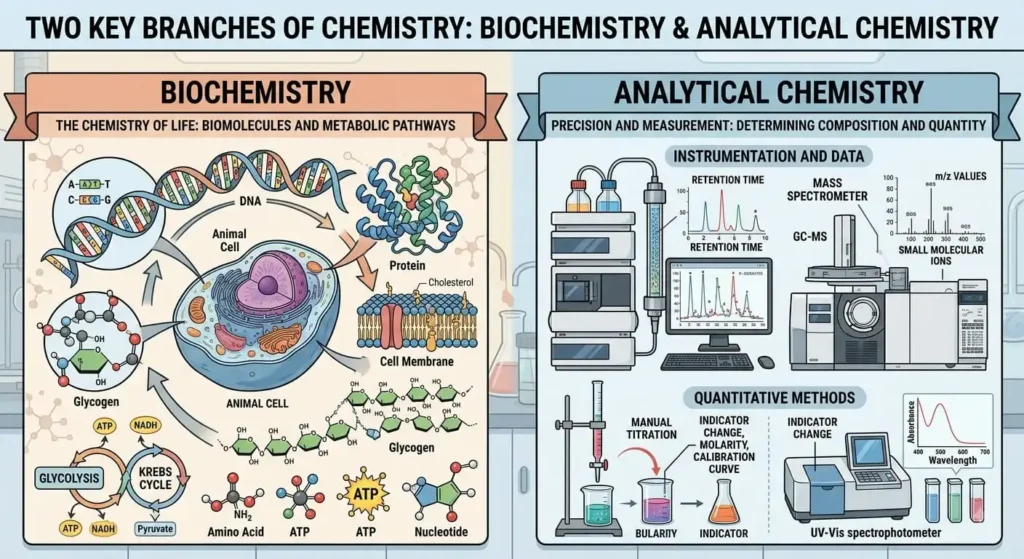
Analytical chemistry is the branch of chemistry that identifies and measures the chemical
components of a substance. It helps scientists determine what a material contains and how
much of each substance is present.
Real-Life Examples
● Testing drinking water for harmful chemicals
● Blood and urine tests in hospitals
● Food quality testing
● Detecting pollutants in the environment
Without analytical chemistry, it would be difficult to ensure the safety of medicines, food, and
drinking water.
Where Is Analytical Chemistry Used?
● Hospitals and medical laboratories
● Food and beverage industry
● Environmental monitoring
● Pharmaceutical companies
● Forensic science
Biochemistry
Biochemistry is the branch of chemistry that studies the chemical processes inside living
organisms. It combines chemistry and biology to explain how our bodies function.
Every time you eat food, breathe, or exercise, thousands of chemical reactions take place inside
your body. Biochemistry helps us understand these reactions.
Real-Life Examples
● Digestion of food
● DNA and genetics
● Protein formation
● Enzyme activity
● Hormone production
Where Is Biochemistry Used?
● Medicine
● Biotechnology
● Genetics
● Nutrition
● Medical research
Biochemistry has played a major role in developing vaccines, understanding diseases, and
improving healthcare around the world.
Other Important Branches of Chemistry
Besides the five main branches, chemistry has several specialized fields that solve modern-day
challenges.
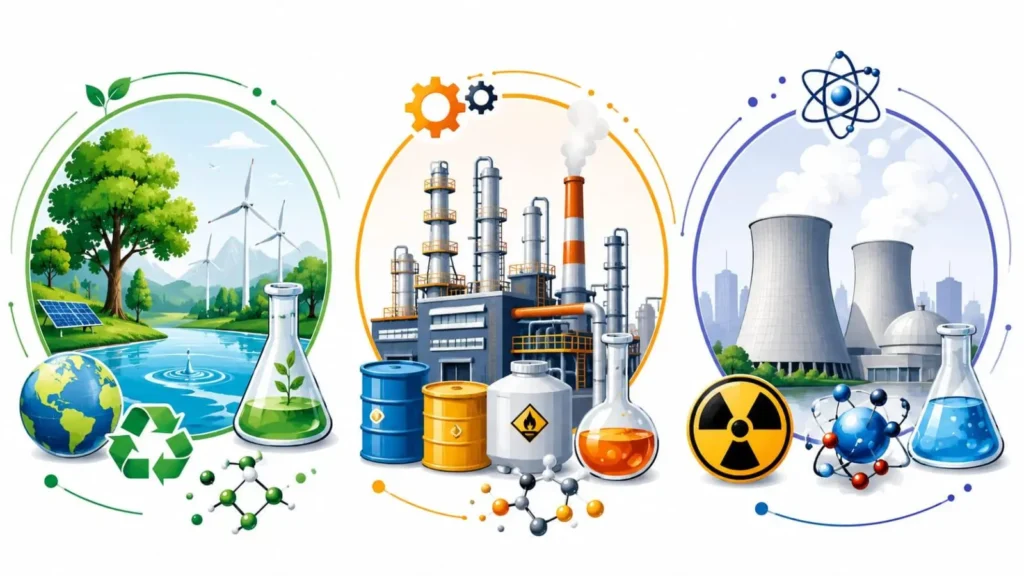
Environmental Chemistry
Environmental chemistry studies the chemicals present in air, water, and soil. It helps scientists
understand pollution and find ways to protect the environment.
● Applications
● Water purification
● Air pollution control
● Waste management
● Climate change research
Industrial Chemistry
Industrial chemistry focuses on manufacturing useful products on a large scale. It combines
chemistry with engineering to produce items we use every day.
Application
● Fertilizers
● Paints
● Plastics
● Soap and detergents
● Cement
Nuclear Chemistry
Nuclear chemistry studies radioactive substances and nuclear reactions. It plays an important
role in medicine, energy production, and scientific research.
Applications
● Cancer treatment (Radiotherapy)
● Nuclear power plants
● Medical imaging
● Scientific research
Why Are the Branches of Chemistry Important?
Each branch of chemistry has a unique role, but together they help us understand the world in
remarkable ways. From developing life-saving medicines to producing clean energy and
protecting the environment, chemistry is at the heart of countless scientific advancements.
Here’s a quick summary:
Organic Chemistry focuses on carbon compounds used in medicines, fuels, and plastics.
Inorganic Chemistry studies metals, minerals, and non-carbon substances used in
construction and manufacturing.
Physical Chemistry explains how chemical reactions occur and how energy affects matter.
Analytical Chemistry identifies and measures substances to ensure quality and safety.
Biochemistry explores the chemical processes inside living organisms.
Together, these branches make modern life safer, healthier, and more innovative.
Conclusion
Chemistry is much more than formulas and laboratory experiments—it’s the science that helps
us understand everything around us. Each branch of chemistry has its own purpose, whether it’s
creating new medicines, developing stronger materials, testing food quality, or protecting our
environment.
By learning the branches of chemistry, you gain a clearer picture of how science improves
everyday life. Whether you’re a student preparing for exams or simply curious about the world,
understanding these branches is a great first step into the fascinating world of chemistry.
Keep exploring, keep asking questions, and you’ll discover that chemistry isn’t just a
subject—it’s a part of everyday life.
One Reply to “Branches of Chemistry: Types, Examples & Applications”